|
 |
 |
 |
 |
 |
 |
 |
 |

 |
MIT Researchers Seek Ocean On Jupiter's Moon Through Its Sounds
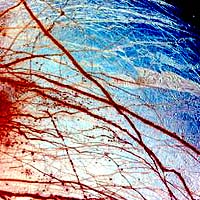
Cambridge - June 4, 2001 Acoustic techniques used by Massachusetts Institute of Technology researchers to explore the Arctic Ocean may help determine whether there is a vast liquid ocean under the ice blanketing Jupiter's moon, Europa. MIT researchers report June 5 at the Chicago meeting of the Acoustical Society of America that they may be able to use a technique similar to ultrasound or the sonar navigation used by bats and dolphins to gather information about Europa. MIT ocean engineering professor Nicholas C. Makris said that implanting soda-can-sized sensors in Europa's icy exterior could provide researchers with information on the temperature and structure of the planet. Current sensor technology makes it possible to detect even tiny motions, and there is evidence that massive ice fractures on Europa's surface occur daily. While such an experiment may be a decade or more away, this unconventional approach to planetary exploration would have to begin to be developed now, Makris said. An array of geophones on the icy surface could simultaneously localize discrete events such as fractures and determine the moon's ice-layer thickness as well as the thickness of a potential ocean layer. Searching For Water Europa may be the only entity in our solar system besides Earth that contains a great deal of water, researchers say, and this mission would represent the first time ocean scientists have been involved in planetary exploration. Gravity and magnetic data collected by the NASA Galileo Orbiter over the past five years have provided increasing evidence that an ocean exists underneath Europa's uniform, 10- to 100-kilometer thick coat of ice. The possible ocean on Europa may contain more liquid water than all the oceans on Earth combined. Magnetic studies have indicated that there must be a conducting layer in Europa. A salty ocean would fit the bill. Researchers hope to discover whether Europa is made up entirely of mushy ice or if it contains an ocean. Where there is water, there may be life. Using Sound To "See" Pictures of the planet show odd, cusp-shaped cracks in the surface. Europa's numerous fractures and ridges are believed to have formed in response to tidal deformations generated by the moon's slightly eccentric 85-hour orbit around Jupiter. Inspired by evidence for these regularly occurring ice fractures, the MIT researchers propose probing Europa's interior by deploying an array of surface microphones that listen to naturally occurring sound. Knowledge of ice mechanics suggests that these propagating fractures would generate significant acoustic energy in the frequency range 0.1-100 Hz. Studying the ice sounds would allow researchers to see if there was a connection between the moon's orbital period and the ice fractures, which occur on Europa once every 30 seconds. Meteors impact Europa about once a month and these also could be used as sound sources. An Arctic Exploration MIT researchers led by Makris, Doherty Professor of Ocean Utilization in MIT's Department of Ocean Engineering, have used sound-based techniques to explore the Arctic Ocean. By inserting vibration-sensitive hydrophones in the water, researchers used ambient sound to listen for changes in noise levels. They found that noise levels increased when winds and currents put stresses on the ice. "Noise levels are like a thermometer for stress on the ice," Makris said. "The ice is very sensitive and conducive to sound." Sound waves made by large fractures go through the ice and penetrate into the ocean. These low-frequency sound waves, akin to those created by whales, get trapped and can propagate hundreds of kilometers through the water. Even if they can't be heard, instruments can pick up their vibrations from a distance. In addition to Makris, the research team includes ocean engineering postdoctorate associates Aaron M. Thode and Michele Zanolin and graduate students Sunwoong Lee, Purnima Ratilal and Joshua Wilson. This work is funded by the Office of Naval Research. Makris is the Secretary of the Navy/Chief of Naval Operations Scholar of Oceanographic Sciences. Community Email This Article Comment On This Article Related Links Galileo Portal at JPL MIT SpaceDaily Search SpaceDaily Subscribe To SpaceDaily Express Space
 Satellite Launch To Boost DTH In India
 Calcutta, India (SPX) Dec 28, 2005
The successful launch Thursday of India's heaviest satellite from spaceport of Kourou in French Guyana may have boosted the country's space research efforts to yet another level, but it has also lifted the spirits of at least three Direct-To-Home televisions broadcasters, one of which has been waiting for years to launch its services in India. |
|
|

|
|
|
|
|
|
|
|
|
|
|
|
| The content herein, unless otherwise known to be public domain, are Copyright 1995-2006 - SpaceDaily.AFP and UPI Wire Stories are copyright Agence France-Presse and United Press International. ESA PortalReports are copyright European Space Agency. All NASA sourced material is public domain. Additionalcopyrights may apply in whole or part to other bona fide parties. Advertising does not imply endorsement,agreement or approval of any opinions, statements or information provided by SpaceDaily on any Web page published or hosted by SpaceDaily. Privacy Statement |