
 |
 |
 |
 |
 |
 |
 |
 |
 |

 |
MIT's Lincoln Lab Upgrades Sputnik-Era Antenna
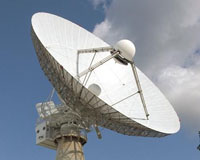
MIT Lincoln Laboratory Cambridge MA (SPX) Aug 14, 2008 A mammoth MIT antenna installed in 1957 as the first radar system to conduct space surveillance (it observed the Sputnik satellite) is poised for many more years of key observations thanks to a recently completed renovation. Lincoln Laboratory's Millstone Hill Radar (MHR) antenna is one of the world's principal tools for maintaining the Deep Space Catalog--the listing of the more than 3000 objects circling the Earth 40,000 km away in geosynchronous earth orbit (GEO). Together with two other surveillance radars--ARPA Long-Range Tracking and Instrumentation Radar (ALTAIR, in the Marshall Islands) and Globus II (in Norway), it monitors the increasingly cluttered geosynchronous orbit to reduce the probability of collisions. The three also monitor satellite and spacecraft launches. But the venerable MHR system was showing its age. The motors and motor generators replaced in this renovation were original 1950s era equipment. "They were past their end of life. The motors were worn from years of use and regular rebuilds, and the inefficient motor generators were failing frequently," says Paula Ward of Lincoln's Control Systems Engineering group. Each failure would shut down the antenna for a significant period of time. Now the system, which consists of an 84-foot-diameter (25 m) reflector supported by a tower a little over 85 feet high (26 m), is easier to troubleshoot, and downtime can be kept to a minimum. Jeff Dominick, the site manager of the Lincoln Space Surveillance Complex (LSSC) that includes MHR, stresses the importance of MHR to LSSC and how important LSSC, in turn, is to the Air Force Space Command. "Losing MHR for any period of time would impact our ability to track in this region," he says, pointing to the arc of GEO above the United States that isn't covered by ALTAIR and Globus II. As project lead of the recent upgrade, Ward was working with two extremes--very heavy and bulky motors and gear boxes, and new software controls running in a real-time embedded environment. For example, installing and aligning the new motors and gear boxes was challenging since no mechanical computer-aided-design models existed. At the other end of the spectrum, while many upgrades had been done to the radar system and associated computers over the years, the antenna control system had been upgraded only twice in the last fifty years. Prior to the upgrade, an operator needing to move the antenna for maintenance had to turn mechanical knobs to rotate the antenna and read meters on a panel indicating positions. Now the interface is more intuitive and is done on a laptop. The operator simply sets the desired positions, and clicks Run. In addition, the upgraded system provides, for the first time, remote access to the antenna's local displays. Dominick concludes, "We're trying to reduce the probability of collisions. This upgrade has significantly reduced downtime and maintenance tasks associated with the MHR antenna control system." Community Email This Article Comment On This Article Share This Article With Planet Earth
Related Links Millstone Hill Radar (MHR) Space Technology News - Applications and Research
 GMV Releases Hifly 6 Satellite Control System
 Rockville MD (SPX) Aug 12, 2008
GMV has released version 6.0 of its popular hifly Satellite Control System. hifly 6.0, is the latest version of its 100 percent flight-proven communication satellite operation software that supports satellites built by manufacturers around the world from launch and early operation procedures (LEOP) to routine on-station operations of satellites. |
|
|

| The content herein, unless otherwise known to be public domain, are Copyright 1995-2007 - SpaceDaily.AFP and UPI Wire Stories are copyright Agence France-Presse and United Press International. ESA Portal Reports are copyright European Space Agency. All NASA sourced material is public domain. Additional copyrights may apply in whole or part to other bona fide parties. Advertising does not imply endorsement,agreement or approval of any opinions, statements or information provided by SpaceDaily on any Web page published or hosted by SpaceDaily. Privacy Statement |
 del.icio.us
 Digg
Digg Reddit
 YahooMyWeb
 Google
 Facebook