
 |
 |
 |
 |
 |
 |
 |
 |
 |

 |
MESSENGER Spacecraft Reveals More Hidden Territory On Mercury
Washington DC (SPX) Oct 30, 2008 A NASA spacecraft gliding over the battered surface of Mercury for the second time this year has revealed more previously unseen real estate on the innermost planet. The probe also has produced several science firsts and is returning hundreds of new photos and measurements of the planet's surface, atmosphere and magnetic field. The Mercury Surface, Space Environment, Geochemistry, and Ranging, or MESSENGER, spacecraft flew by Mercury shortly after 4:40 a.m. EDT, on Oct. 6. It completed a critical gravity assist to keep it on course to orbit Mercury in 2011 and unveiled 30 percent of Mercury's surface never before seen by a spacecraft. "The region of Mercury's surface that we viewed at close range for the first time this month is bigger than the land area of South America," said Sean Solomon, principal investigator and director of the Department of Terrestrial Magnetism at the Carnegie Institution of Washington. "When combined with data from our first flyby and from Mariner 10, our latest coverage means that we have now seen about 95 percent of the planet." The spacecraft's science instruments operated throughout the flyby. Cameras snapped more than 1,200 pictures of the surface, while topography beneath the spacecraft was profiled with a laser altimeter. The comparison of magnetosphere observations from the spacecraft's first flyby in January with data from the probe's second pass has provided key new insight into the nature of Mercury's internal magnetic field and revealed new features of its magnetosphere. The magnetosphere is the volume surrounding Mercury that is controlled by the planet's magnetic field. "The previous flybys by MESSENGER and Mariner 10 provided data only about Mercury's eastern hemisphere," explains Brian Anderson of the Johns Hopkins University Applied Physics Laboratory, known as APL, in Laurel, Md. "The most recent flyby gave us our first measurements on Mercury's western hemisphere, and with them we discovered that the planet's magnetic field is highly symmetric." The probe's Mercury Laser Altimeter, or MLA, measured the planet's topography, allowing scientists, for the first time, to correlate high-resolution topography measurements with high-resolution images. "The MLA collected altimetry in regions where images from MESSENGER and Mariner 10 data are available, and new images were obtained of the region sampled by the altimeter in January," said Maria Zuber, co-investigator and head of the Department of Earth, Atmospheric, and Planetary Sciences at the Massachusetts Institute of Technology. "These topographic measurements now improve considerably the ability to interpret surface geology." The Mercury Atmospheric and Surface Composition Spectrometer observed Mercury's thin atmosphere, known as an exosphere. The instrument searched for emissions from sodium, calcium, magnesium, and hydrogen atoms. Observations of magnesium are the first detection of this chemical in Mercury's exosphere. Preliminary analysis suggests that the spatial distributions of sodium, calcium, and magnesium are different. Simultaneous observations of these spatial distributions, also a first for the spacecraft, have opened an unprecedented window into the interaction of Mercury's surface and exosphere. Spacecraft images also are revealing for the first time vast geologic differences on the surface. "Now that MESSENGER's cameras have imaged more than 80 percent of Mercury, it is clear that, unlike the moon and Mars, Mercury's surface is more homogeneously ancient and heavily cratered, with large extents of younger volcanic plains lying within and between giant impact basins," said co-investigator Mark Robinson of Arizona State University in Tempe. The project is the seventh in NASA's Discovery Program of lower-cost, scientifically focused missions. APL designed, built and operates the spacecraft and manages the mission for NASA's Science Mission Directorate in Washington. Science instruments were built by APL; NASA's Goddard Space Flight Center in Greenbelt, Md.; the University of Michigan, Ann Arbor; and the University of Colorado, Boulder. GenCorp Aerojet of Sacramento, Calif., and Composite Optics Inc. of San Diego, provided the propulsion system and composite structure. Community Email This Article Comment On This Article Share This Article With Planet Earth
Related Links Mercury mission News Flash at Mercury Mars News and Information at MarsDaily.com Lunar Dreams and more
 MESSENGER Gains Speed
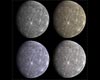 Laurel MD (SPX) Oct 20, 2008
Shortly after 4 a.m. this morning, MESSENGER reached its greatest speed relative to the Sun. The spacecraft, nearly 70% closer to the Sun than Earth, was traveling nearly 140,880 miles per hour (62.979 kilometers per second) relative to the Sun. |
|
|

| The content herein, unless otherwise known to be public domain, are Copyright 1995-2007 - SpaceDaily.AFP and UPI Wire Stories are copyright Agence France-Presse and United Press International. ESA Portal Reports are copyright European Space Agency. All NASA sourced material is public domain. Additional copyrights may apply in whole or part to other bona fide parties. Advertising does not imply endorsement,agreement or approval of any opinions, statements or information provided by SpaceDaily on any Web page published or hosted by SpaceDaily. Privacy Statement |
 del.icio.us
 Digg
Digg Reddit
 YahooMyWeb
 Google
 Facebook