|
 |
 |
 |
 |
 |
 |
 |
 |

 |
MERIS Monitoring Tracks Planetary Photosynthesis Levels
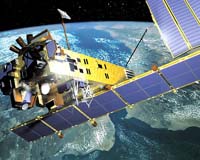
Paris, France (ESA) Sep 26, 2005 Daily multispectral observations from Envisat's MERIS sensor are being combined with a sophisticated processing algorithm and powerful Grid computing to reveal global photosynthesis activity on land. This permits researchers to trace the state of health of terrestrial plant cover, identifying areas under stress and assessing damage from drought or fires. An algorithm developed by the European Commission's Joint Research Centre (EC-JRC) in Ispra, Italy is the basis for global monthly photosynthesis maps derived from MERIS imagery. Their production represents a demanding data-processing task only made possible on a routine basis through the Earth Science Grid-On-Demand service available from ESRIN, the European Centre for Earth Observation, in Frascati. Maps of anomalies in photosynthesis levels over European countries have then been produced by scientists at the Institute for Environment and Sustainability of EC-JRC, based on observations gathered from 1998 to 2002. Grid-processed results shown here indicate a decrease in vegetation activity against the average for Spain and Portugal, due to unusually cold and dry conditions at the beginning of the year, leading to plant stress. In the past the effects of the 2003 European drought were detected in a similar way, but in the absence of any long-term continental-scale perspective on vegetation growth. Forget fossil fuels and nuclear plants: on a global scale solar power is the dominant source of energy. Across land and sea, our world's plant life uses the process called photosynthesis to convert incoming sunlight into chemical energy, along the way producing all the oxygen we breathe. The fraction of incoming solar radiation useful for photosynthesis that is actually absorbed by vegetation � a value known as the Fraction of Absorbed Photosynthetically Active Radiation (FAPAR) � is well-recognised as an indicator of its condition and an influence on its capacity for growth, or 'productivity'. FAPAR has been recognised as a fundamental surface parameter by international organisations including the Global Climate Observing System (GCOS), charged with providing data on the Earth's climate system. Vegetation plays a critical role on Earth as all animals and humans ultimately depend on it for food. Plants often provide a local habitat for other species to live in, and constitute a major source of raw materials for human activities. Wood in particular constitutes a critical source of energy storage for a large fraction of humanity which relies on it for heating and cooking. It is especially significant as a 'sink' of carbon that might otherwise enter the atmosphere as carbon dioxide and hasten global warming. Envisat's Medium Resolution Imaging Spectrometer (MERIS) acquires multispectral imagery of the Earth, and is used to monitor the state and evolution of the planetary vegetation cover. In particular the instrument's standard Level-2 product on land, known as the MERIS Global Vegetation Index (MGVI) provides FAPAR values based on reflected radiation from the Earth's land surface. EC-JRC is responsible for the processing algorithm that yields the MGVI product. "It is a complex task to extract the required information from the reflected light MERIS measures," explains Nadine Gobron of EC-JRC. "It requires the development of mathematical tools to minimise the effects due to scattering from atmospheric particles, the presence of soils and the changing geometry of illumination and observation." The validation of MGVI is in fact an ongoing activity, along with that for a family of related FAPAR algorithms developed by JRC for other satellite sensors, including NASA's MODIS and SeaWiFS, intended to ensure the availability of a long time series of global products. The latter are essential to assess environmental trends, guide policy making and support sustainable development. "Considerable efforts are made to evaluate the quality of the MGVI and comparable products," explains Gobron. "This takes place both through inter-comparisons between the products generated by various instruments and by direct comparisons with field measurements. These ongoing efforts involve not only ESA Cal/Val groups but similar international groups including CEOS as well as close collaborations with major research programmes, such as CarboEurope funded by the European Union." The monthly FAPAR anomaly products are an example of close cooperation between ESRIN and EC-JRC. The products are basically mosaics created from multiple images acquired by MERIS over the course of the month. Handling and processing this much data is extremely demanding in processing power, but ESRIN's Grid-On-Demand service makes it feasible. Grid computing takes its name and organising principle from the electricity grid: anything one computer can do, a pool of computers can do faster and better. These machines do not have to be in the same building, country or even continent � they simply have to be linked together. A Grid provides its user with massive amounts of memory and processing power in order to tackle very complex tasks. ESRIN has taken up Grid computing as a means of supporting its primary task: to archive and distribute an ever growing volume of Earth Observation data. Since the start of this year the Earth Science Grid-On-Demand service has been available to registered users. It allows access to a large amount of data and the swift performance of a wide variety of data processing. Envisat's MERIS sensor acquires optical multispectral imagery of Earth's oceans, land and atmosphere. It and a fellow Envisat instrument are the subject of next week's MERIS and AATSR Workshop. More than 200 Principal Investigators from 30 countries will gather at ESRIN, the European Centre for Earth Observation in Frascati near Rome, for the five-day event beginning Monday 26 September. Community Email This Article Comment On This Article Related Links Envisat overview SpaceDaily Search SpaceDaily Subscribe To SpaceDaily Express Earth Observation News - Suppiliers, Technology and Application
 New Legislation Initiated To Support Commercial Remote Sensing Industry
 New York NY (SPX) Jan 11, 2006
The importance of remotely sensed data and technologies to support natural disasters has prompted attention and action in Washington. New initiatives and legislation authorizing appropriations to the remote sensing industry will be discussed at Strategic Research Institute's U.S. Commercial Remote Sensing Industry conference, scheduled for February 9-10, 2006 in Washington D.C. |
|
|

| The content herein, unless otherwise known to be public domain, are Copyright 1995-2006 - SpaceDaily.AFP and UPI Wire Stories are copyright Agence France-Presse and United Press International. ESA PortalReports are copyright European Space Agency. All NASA sourced material is public domain. Additionalcopyrights may apply in whole or part to other bona fide parties. Advertising does not imply endorsement,agreement or approval of any opinions, statements or information provided by SpaceDaily on any Web page published or hosted by SpaceDaily. Privacy Statement |