|
 |
 |
 |
 |
 |
 |
 |
 |

 |
MELT Data Sheds New And Surprising Light On Birth Of Oceanic Plates
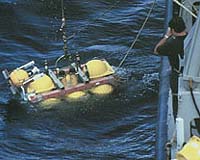
Providence RI (SPX) Sep 14, 2005 The East Pacific Rise, a vast volcanic mountain range submerged in the eastern Pacific Ocean, is one of the fastest seafloor factories on the planet. Here, along a rocky spine that runs about 1,000 miles west of South America, oceanic crust is created from magma bubbling up from deep within Earth's interior. Forces that shape these young oceanic plates have come into clearer focus through research conducted by scientists at the Woods Hole Oceanographic Institution, Brown University and the Japan Agency for Marine-Earth Science and Technology. The research represents the first time that seismic and electromagnetic data were analyzed in tandem from 1995 Mantle Electromagnetic and Tomography, or MELT, Experiment. MELT employed 51 ocean-bottom seismometers and 30 magnetotelluric receivers two miles under the sea to measure sound waves and magnetic fields along the East Pacific Rise, making it one of the largest marine geophysical experiments ever conducted. In a paper published in Nature, the team notes that in rock down to a depth of about 60 kilometers below the ocean floor, electrical currents conduct poorly and sound waves travel rapidly. Deeper down, beyond 60 kilometers, there is a dramatic increase in electrical conductivity, and sound waves travel at their slowest. A switch in seismic and electrical properties with depth was expected. Researchers were surprised, however, at how close to the East Pacific Rise this structure develops and how little it changes with increasing distance from the rise. Brown marine geophysicist Donald Forsyth said the team, led by Robert Evans from the Woods Hole Oceanographic Institution, has a theory about the cause of the sudden compositional changes at 60 kilometers: dehydration. As magma migrates to the surface to form crust at the rise, it leaves behind a dry, residual layer about 60 kilometers thick. This change from "dry" surface rock to "damp" rock below it increases electrical conductivity and slows seismic velocity, the researchers write. Here is what they did not expect: These changes occur, the team found, less than 100 kilometers away from the highest point on the ridge. And the seismic and electrical measurements remained nearly constant at least about 500 kilometers away from the crest. Separating seafloor guides magma up to mid-ocean ridges such as the East Pacific Rise, where the molten rock erupts, fans out along the ocean floor and cools to form new crust. Cooling allows sound waves and electrical currents to travel faster. But scientists thought this cooling � and the resulting changes in the rock � would be gradual. "About two-thirds of the Earth's surface is oceanic crust � and it is all formed at ridges," Forsyth said. "So this work helps us better understand the basic processes of how this crust is formed." The National Science Foundation funded MELT and the latest research. Community Email This Article Comment On This Article Related Links SpaceDaily Search SpaceDaily Subscribe To SpaceDaily Express Tectonic Science and News
 Ash Continuing To Spew From Vanuatu Volcano
 Sydney (AFP) Dec 12, 2005
Thousands of tonnes of ash are continuing to spew from a volcano in Vanuatu, but officials said Monday the activity on the South Pacific nation was not likely to result in a major deadly eruption. |
|
|

| The content herein, unless otherwise known to be public domain, are Copyright 1995-2006 - SpaceDaily.AFP and UPI Wire Stories are copyright Agence France-Presse and United Press International. ESA PortalReports are copyright European Space Agency. All NASA sourced material is public domain. Additionalcopyrights may apply in whole or part to other bona fide parties. Advertising does not imply endorsement,agreement or approval of any opinions, statements or information provided by SpaceDaily on any Web page published or hosted by SpaceDaily. Privacy Statement |