|
 |
 |
 |
 |
 |
 |
 |
 |

 |
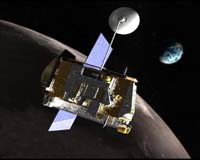
Lunar Reconnaissance Orbiter Successfully Completes Critical Design Review
Greenbelt MD (SPX) Dec 08, 2006 The Lunar Reconnaissance Orbiter (LRO) successfully completed its Critical Design Review (CDR) on Thursday, November 9, 2006. The review was held to present the complete system design developed at NASA's Goddard Space Flight Center, and to make sure that technical issues have been properly addressed. Additionally, it ensured that the design maturity justifies the start of manufacturing mission hardware and software. As a result of this major assessment, NASA's independent review board provided a green light for proceeding into the fabrication and integration phase of the project. The first in a series of robotic missions to the moon, the lunar orbiter is scheduled for launch in October 2008. It will carry six science instruments and a technology demonstration. The mission goal is to expand the coverage and accuracy of lunar maps and environmental data, enabling selection of landing sites for future robotic and human lunar missions. "LRO will lead the way for NASA to reduce many of the major physical uncertainties in the basic definition of the moon itself, especially filling in gaps in our understanding of lunar topography, temperature, and resources including potential hydrogen and water, and in the information about the lunar poles," said Tony Lavoie, NASA's Lunar Precursor and Robotic Program Manager. "A solid performance as a result of this CDR review allows us to have high confidence that the LRO team at Goddard will make it to the launch pad on time for this crucial launch." LRO is part of NASA's Lunar Precursor and Robotic Program, located at the Marshall Space Flight Center, Huntsville, Ala. The LRO Critical Design Review began November 6, 2006 at NASA Goddard in Greenbelt, Md., where LRO will be built. The independent review board, comprised of reviewers from NASA and several external organizations, heard presentations on all aspects of LRO design. Presentations included the spacecraft construction and systems integration, the science operations center, testing, and safety requirements. Critical Design Reviews are one-time programmatic events that bridge the design and manufacturing stages of a project. A successful review means that the design is validated and will meet its requirements, is backed up with solid analysis and documentation, and has been proven to be safe. LRO's CDR completion grants Goddard permission to begin manufacturing hardware. Community Email This Article Comment On This Article Related Links Lunar Reconnaissance Orbiter Lunar Dreams and more Mars News and Information at MarsDaily.com Lunar Dreams and more
 Russia Plans Lunar Mission In 2012, Eyes US Lunar Return Partnership
 Moscow, Russia (RIA Novosti) Dec 08, 2006
Russia will launch its first major mission to the Moon, Luna-Glob, in 2012 after a 30-year break from lunar exploration, a space agency spokesman said Thursday. |
|
|

| The content herein, unless otherwise known to be public domain, are Copyright 1995-2006 - SpaceDaily.AFP and UPI Wire Stories are copyright Agence France-Presse and United Press International. ESA PortalReports are copyright European Space Agency. All NASA sourced material is public domain. Additionalcopyrights may apply in whole or part to other bona fide parties. Advertising does not imply endorsement,agreement or approval of any opinions, statements or information provided by SpaceDaily on any Web page published or hosted by SpaceDaily. Privacy Statement |