|
 |
 |
 |
 |
 |
 |
 |
 |

 |
Lunar Mini-Camera Tells The Moon To Say "Cheese"
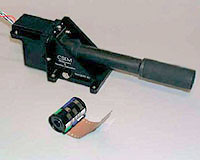
Paris, France (ESA) Nov 15, 2004 Since its Ariane launch from Kourou in September 2003, the small but remarkable SMART-1 satellite has been silently spiralling its way to the Moon. As from mid November, it will be captured by the lunar gravity. Next January it will reach its final orbit and start science observations. This week EuroNews talks to the SMART-1 AMIE camera team. SMART-1 is a technology demonstrator into which the European Space Agency has packed many innovative space techniques to be used on future interplanetary missions. Above all, it has validated a solar-powered ion engine as the main propulsion system, used for the first time on a European science satellite. Compactness and miniaturisation are key features of SMART-1 and its science instruments. EuroNews 'Space' magazine has met two of the Swiss astronomers behind its miniature lunar colour camera called AMIE. "Our team is extremely motivated and flexible," explains designer Jean-Luc Josset, Director of the Space-X Space Exploration Institute in Neuch�tel. "We rose to the challenges of providing a light-weight unit for a very small satellite. In just five years, we packed it all into only 500 grams, and now we are able to take unique pictures of the Moon." In its final operational orbit, SMART-1 will be circling between 3,000 and 300 kilometres over the Moon's poles. AMIE will be able to map a 2,000 km large impact basin on the far side of the Moon, created by a giant bombardment 4 billion years ago. It will also look at polar craters whose bottom is never reached by sunlight. Other SMART-1 science instruments will also contribute to a first comprehensive survey of key chemical elements on the lunar surface. "With AMIE we hope to map inside permanently shadowed areas. The SIR spectrometer will be obtaining the surface composition," explains Bernard Foing, ESA's SMART-1 project scientist. "The mission may be able to confirm the presence of permanent ice which may have been brought by meteorites before being trapped in the coldest areas." The AMIE camera has already demonstrated its qualities during the journey to the Moon. It has looked back and taken vivid pictures of mother Earth. It also observed from space the total lunar eclipse on 28 October. "We were in a strategic position when we obtained these views of the unlit Moon," recalls St�phane Beauvivre of the Space-X Institute. "SMART-1 was then 300,000 km from our planet, between the Sun and the Earth, and our Moon was even farther at more than 600,000 km. The eclipse was followed this way for the very first time. We were overjoyed seeing the entire planet and to follow the Moon passing into the Earth's shadow and being totally occulted." In a few weeks time, the AMIE camera will be opening more new ground, snapping the Moon in colour at close quarters and from a variety of viewing angles. Scientists will be getting unique data that will help them better understand its composition and how it was formed. One thing is sure: the Moon will have to smile for the AMIE camera! Community Email This Article Comment On This Article Related Links Europe goes to the Moon Advanced Moon micro-Imager Experiment (AMIE) Space-X SpaceDaily Search SpaceDaily Subscribe To SpaceDaily Express Mars News and Information at MarsDaily.com Lunar Dreams and more
 SMART 1 Uses New Imaging Technique In Lunar Orbit
 Paris, France (ESA) Dec 28, 2005
ESA's SMART-1 spacecraft has been surveying the Moon's surface in visible and near-infrared light using a new technique, never before tried in lunar orbit. |
|
|

| The content herein, unless otherwise known to be public domain, are Copyright 1995-2006 - SpaceDaily.AFP and UPI Wire Stories are copyright Agence France-Presse and United Press International. ESA PortalReports are copyright European Space Agency. All NASA sourced material is public domain. Additionalcopyrights may apply in whole or part to other bona fide parties. Advertising does not imply endorsement,agreement or approval of any opinions, statements or information provided by SpaceDaily on any Web page published or hosted by SpaceDaily. Privacy Statement |