|
 |
 |
 |
 |
 |
 |
 |
 |

 |
Low Level Of Extinction During Ice Age Linked To Adaptability
Baltimore MD (SPX) May 2, 2005 A Johns Hopkins University graduate student may have figured out why rates of extinction were so low for many of the major groups of marine life during one of the greatest ice ages, which occurred from about 330 million to 290 million years ago, late in the Paleozoic Era. The likely answer: because those aquatic life forms that did survive during this era were singularly equipped to endure severe fluctuations in temperature and sea levels. Those that were not died in a mass extinction that heralded the ice age's onset. "These results not only clue us in to what happened many millions of years ago, but they also have implications for understanding the modern marine ecosystem," said Matthew Powell, a doctoral candidate in the Morton K. Blaustein Department of Earth and Planetary Sciences at The Johns Hopkins University's Zanvyl Krieger School of Arts and Sciences. His paper on the topic appears in the May issue of Geology, published by the Geological Society of America. "If the patterns I detected also are true for the modern ice age - and other researchers' results suggest that they may be - then modern marine life ought to be relatively resistant to extinction," he said. "Yet species are dying off at an alarming rate. It may be that humans have altered the environment so much that we are now causing the extinction of species that should be relatively immune. Though it's difficult to say exactly what the implications are for the world we live in, what I can say is that it is worrisome." Powell looked at extinctions during an age when glaciers reached to within 35 degrees of the equator, roughly as far south as a line between present-day Raleigh, Memphis and Albuquerque or nearly as far north as Buenos Aires. Powell tackled the question of why extinction rates were so low during that great ice age by closely examining geographic patterns of evolution and extinction in brachiopods, simple shelled sea creatures that were abundant and well-fossilized during the Paleozoic. He constructed a database that charted latitudinal patterns of evolution and extinction through the late Paleozoic. "This database is the first ever; no other database of this kind exists for any interval of geologic time, from which to study geographic patterns of macroevolution," Powell said. According to Powell's analysis, brachiopods that lived primarily near the equator suffered the highest extinction rates and did not re-appear in great numbers until the ice age ended. "The absence of these particular brachiopods during the ice age left the oceans populated almost entirely with those who lived over a wider geographic area," Powell said. "What I found is that the uniquely low global rates of evolution and extinction for brachiopods during the late Paleozoic ice age were caused by the loss and lack of recovery of those that had existed in narrow latitudinal ranges." Powell believes that those brachiopods that existed within narrow latitudinal ranges became victims of the extremes in the annual minimum and maximum temperatures that were typical of the late Paleozoic. During that era, "seasonality" - the difference between annual temperatures' highs and lows - was amplified by the presence of glaciers. "I've suggested that those brachiopods which eventually became extinct had adapted only to small temperature changes, and thus did not survive," he said. "The other competing hypothesis is that large fluctuations of sea level, driven by the melting and reforming of glaciers, disrupted marine communities, and the ones which survived were those able to adjust. Community Email This Article Comment On This Article Related Links http://www.jhu.edu/ SpaceDaily Search SpaceDaily Subscribe To SpaceDaily Express Nuclear Space Technology at Space-Travel.com
 Rewriting Glacial History In Pacific North America
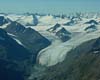 Edmonton AB (SPX) Jan 10, 2006
Although the story on glacier fluctuations in northwestern North America over the last 10,000 years has remained largely unchanged for decades, new evidence discovered by a University of Alberta researcher will rewrite that glacial history and offer clues about our climate history during the last several thousand years. |
|
|

| The content herein, unless otherwise known to be public domain, are Copyright 1995-2006 - SpaceDaily.AFP and UPI Wire Stories are copyright Agence France-Presse and United Press International. ESA PortalReports are copyright European Space Agency. All NASA sourced material is public domain. Additionalcopyrights may apply in whole or part to other bona fide parties. Advertising does not imply endorsement,agreement or approval of any opinions, statements or information provided by SpaceDaily on any Web page published or hosted by SpaceDaily. Privacy Statement |