|
 |
 |
 |
 |
 |
 |
 |
 |

 |
Long Term Plans More Uncertain Than Ever
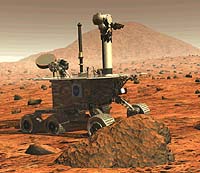
Meanwhile post-2003, the Mars program remains completely up for grabs; with a Houston conference organized earlier this month by NASA as a brainstorming workshop seeing 150 papers presented on ideas for near-future Mars exploration. In among the fun of a clean slate, one group led by xxx Hecht and Chris McKay proposed a 2005 "MarsLab" mission in which a near-duplicate of the cancelled 2001 Mars Surveyor lander -- which carries out a full fledged controlled soft landing on Mars but is then stationary -- might carry those experiments along with four more HEDS experiments that were recently selected to fly piggyback on the cancelled 2003 sample-return lander. This payload would measure the radiation environment of Mars, look for dangerous chemical poisons in the soil, study the dangers that blowing Mars dust may have for both unmanned and manned ships and machines, and test proposed techniques for manufacturing rocket propellant out of Mars' air itself, thus tremendously lowering the weight and cost of any missions that blast off from Mars to return to Earth. It would also make an extremely sensitive analysis of local Mars rocks to look for any organic compounds in them, and study their composition and geology in other ways (including a rerun of the "TEGA" soil-analysis experiment lost on Mars Polar Lander). And it could also test new techniques to maximize the safety of future soft-landing missions to Mars -- which will be crucial despite Pathfinder's bouncing hard-landing system. I think it quite likely that such a spacecraft will be flown in 2005 or 2007. The 2003 Athena mission, though, has other goals. After the lander has unfolded its petals and propped itself upright, the rover will carry out a 360-degree panoramic survey of the landing site, and within a day or two set out in the best direction. Preliminary plans call for it to spend a couple of weeks peering at and analyzing rocks in the immediate vicinity of the lander to ensure some scientific return, before it sets out on its longer trek. Since live radio control from Earth is impossible due to the radio time lag, each day Earth controllers will have to study the photos and other data which the rover has collected, and then give it advance marching orders as to where to drive to next. The next day, Athena will follow these orders, zigzagging to a set of intermediate "waypoints" selected by Earth in order to get to its final stop for the day. While on these individual slow straight-line drives, its computer will analyze the pictures from Athena's own onboard navigation cameras to look for dangerously large rocks or holes that may unexpectedly crop up in its path; it will veer around them (or even back up briefly, if necessary) and then get back onto the original path. This system sounds risky, but visual-recognition programs allowing even fairly fast robot vehicles to steer around obstacles on Earth are now quite sophisticated and reliable -- and Athena will move very slowly. The plan is for it to move a rough average of only 3 cm per second -- which will still allow it to crawl about 100 meters during one hour, which is the maximum it will spend driving on any one day. It will, however, spend most of its time edging up to interesting rocks (or soil patches) and analyzing them. If it drove 100 meters each day, it could travel 9 km during its planned three-month lifetime -- but it will actually only travel 1 to 2 km. And it will spend a lot of time hanging around a series of general areas a few dozen meters across and inspecting individual rocks within them, in order to understand the area's overall geological structure and context as well as possible.
Email This Article Comment On This Article Related Links Space
 Satellite Launch To Boost DTH In India
 Calcutta, India (SPX) Dec 28, 2005
The successful launch Thursday of India's heaviest satellite from spaceport of Kourou in French Guyana may have boosted the country's space research efforts to yet another level, but it has also lifted the spirits of at least three Direct-To-Home televisions broadcasters, one of which has been waiting for years to launch its services in India. |
|
|

| The content herein, unless otherwise known to be public domain, are Copyright 1995-2006 - SpaceDaily.AFP and UPI Wire Stories are copyright Agence France-Presse and United Press International. ESA PortalReports are copyright European Space Agency. All NASA sourced material is public domain. Additionalcopyrights may apply in whole or part to other bona fide parties. Advertising does not imply endorsement,agreement or approval of any opinions, statements or information provided by SpaceDaily on any Web page published or hosted by SpaceDaily. Privacy Statement |