|
 |
 |
 |
 |
 |
 |
 |
 |

 |
Long-Term Increase In Rainfall Seen In Tropics
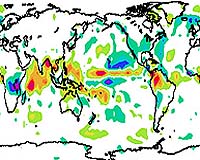
Greenbelt MD (SPX) Aug 28, 2007 NASA scientists have detected the first signs that tropical rainfall is on the rise with the longest and most complete data record available. Using a 27-year-long global record of rainfall assembled by the international scientific community from satellite and ground-based instruments, the scientists found that the rainiest years in the tropics between 1979 and 2005 were mainly since 2001. The rainiest year was 2005, followed by 2004, 1998, 2003 and 2002, respectively. "When we look at the whole planet over almost three decades, the total amount of rain falling has changed very little. But in the tropics, where nearly two-thirds of all rain falls, there has been an increase of 5 percent," says lead author Guojun Gu, a research scientist at Goddard Space Flight Center in Greenbelt, Md. The rainfall increase was concentrated over tropical oceans, with a slight decline over land. Climate scientists predict that a warming trend in Earth's atmosphere and surface temperatures would produce an accelerated recycling of water between land, sea and air. Warmer temperatures increase the evaporation of water from the ocean and land and allow air to hold more moisture. Eventually, clouds form that produce rain and snow. "A warming climate is the most plausible cause of this observed trend in tropical rainfall," says co-author Robert F. Adler, senior scientist at Goddard's Laboratory for Atmospheres. Adler and Gu are now working on a detailed study of the relationship between surface temperatures and rainfall patterns to further investigate the possible link. The study appears in the Aug. 1, 2007, issue of the American Meteorological Society's Journal of Climate. Obtaining a global view of our planet's rainfall patterns is a challenging work-in-progress. Only since the satellite era have regular estimates of rainfall over oceans been available to supplement the long-term but land-limited record from rain gauges. Just recently have the many land- and space-based data been merged into a single global record endorsed by the international scientific community: the Global Precipitation Climatology Project, sponsored by the World Climate Research Program. Adler's research group at NASA produces the project's monthly rainfall updates, which are available to scientists worldwide. Using this global record, Gu, Adler and their colleagues identified a small upward trend in overall tropical rainfall since 1979, but their confidence was not high that this was an actual long-term trend rather than natural year-to-year variability. So they took another look at the record and removed the effects of the two major natural phenomena that change rainfall: the El Nino-Southern Oscillation and large volcanic eruptions. El Nino is a cyclical warming of the ocean waters in the central and eastern tropical Pacific that generally occurs every three to seven years and alters weather patterns worldwide. Volcanoes that loft debris into the upper troposphere and stratosphere create globe-circling bands of aerosol particles that slow the formation of precipitation by increasing the number of small cloud drops and temporarily shielding the planet from sunlight, which lowers surface temperatures and evaporation that fuels rainfall. Two such eruptions - El Chicon in Mexico and Mount Pinatubo in the Philippines - occurred during the 27-year period. The scientists found that during El Nino years, total tropical rainfall did not change significantly but more rain fell over oceans than usual. The two major volcanoes both reduced overall tropical rainfall by about 5 percent during the two years following each eruption. With these effects removed from the rainfall record, the long-term trend appears more clearly in both the rainfall data over land and over the ocean. According to Adler, evidence for the rainfall trend is holding as more data come in. The latest numbers for 2006 show another record-high year for tropical rainfall, tying 2005 as the rainiest year during the period. "The next step toward firmly establishing this initial indication of a long-term tropical rainfall trend is to continue to lengthen and improve our data record," says Adler, who is project scientist of the Tropical Rainfall Measuring Mission (TRMM), a joint mission between NASA and the Japan Aerospace Exploration Agency. The three primary instruments on TRMM are currently providing the most detailed view of rainfall ever provided from space. Adler's group has been incorporating TRMM rainfall data since 1997 into the global rainfall record. NASA plans to extend TRMM's success of monitoring rainfall over the tropics to the entire globe with the Global Precipitation Measurement mission, scheduled for launch in 2013. This international project will provide measurements of both rain and snow around the world with instruments on a constellation of spacecraft flying in different orbits. Community Email This Article Comment On This Article Related Links Global Precipitation Climatology Project Weather News at TerraDaily.com
 Highly Sensitive Weather Radar A Gain For Climate Research
 Delft, Holland (SPX) Aug 27, 2007
TU Delft has taken a new weather radar system into use, the 'Drizzle Radar', which can observe even the lightest of drizzles. This is an enormous gain for climate researchers and is attracting international attention. |
|
|

| The content herein, unless otherwise known to be public domain, are Copyright 1995-2007 - SpaceDaily.AFP and UPI Wire Stories are copyright Agence France-Presse and United Press International. ESA Portal Reports are copyright European Space Agency. All NASA sourced material is public domain. Additional copyrights may apply in whole or part to other bona fide parties. Advertising does not imply endorsement,agreement or approval of any opinions, statements or information provided by SpaceDaily on any Web page published or hosted by SpaceDaily. Privacy Statement |