|
 |
 |
 |
 |
 |
 |
 |
 |

 |
Loneos Discovers Asteroid With The Smallest Orbit
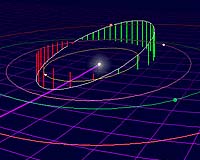
Flagstaff AZ (SPX) May 24, 2004 The ongoing search for near-Earth asteroids at Lowell Observatory has yielded another interesting object. Designated 2004 JG6, this asteroid was found in the course of LONEOS (the Lowell Observatory Near-Earth Object Search) on the evening of May 10 by observer Brian Skiff. "I immediately noticed the unusual motion," said Skiff, "so it was certain that it was of more than ordinary interest." He quickly reported it to the Minor Planet Center (MPC) in Cambridge MA, which acts as an international clearinghouse for asteroid and comet discoveries. The MPC then posted it on a Web page for verification by astronomers worldwide. It happened that all the initial follow up observations, however, were obtained by amateur and professional observers in the Southwest US. The additional sky positions measured in the ensuing few days allowed an orbit to be calculated. The official discovery announcement and preliminary orbit were published by the MPC on May 13. This showed that the object was located between Earth and Venus (presently the very bright "evening star" in the western sky). In addition, 2004 JG6 goes around the Sun in just six months, making it the asteroid with the shortest known orbital period. Ordinary asteroids are located between the orbits of Mars and Jupiter, roughly two to four times farther from the Sun than Earth, taking several years to go around the Sun. Instead, 2004 JG6 orbits entirely within Earth's orbit, only the second object so far found to do so. "What makes this asteroid unique is that, on average, it is the second closest solar system object orbiting the Sun," said Edward Bowell, LONEOS Director. Only planet Mercury orbits closer to the Sun. As shown in the included diagram, JG6 crosses the orbits of Venus and Mercury, passing less than 30 million miles from the Sun every six months. The approximate average orbital speed of this asteroid is more than 30 km/sec, or 67,000 miles per hour. Depending on their locations, the asteroid may pass as close as 3.5 million miles from Earth and about 2 million miles from planet Mercury. In the coming weeks 2004 JG6 will pass between Earth and the Sun, just inside Earth's orbit. It will move through the constellations Cancer and Canis Minor low in the western sky at dusk. Because of the near-exact six-month period, the asteroid should be observable again in nearly the same spot in the sky next May, having gone around the Sun twice while Earth will have made only one circuit. From present estimates, 2004 JG6 is probably between 500 meters and 1 km in diameter. Despite its proximity, the object poses no danger of colliding with Earth. Asteroids with orbits entirely within the Earth's orbit have been informally called "Apoheles," from the Hawaiian word for orbit. Apohele also has Greek roots: "apo" for outside, and "heli" for Sun. Objects orbiting entirely within Earth's orbit are thought by dynamicist William F. Bottke of Southwest Research Institute and colleagues to comprise just two percent of the total near-Earth object population, making them rare as well as difficult to discover. This is because they stay in the daylight sky almost all of the time. There may exist about 50 Apoheles of comparable size to or larger than 2004 JG6, but many of them are certain to be unobservable from the ground. The first asteroid found entirely inside Earth's orbit was 2003 CP20, found just over a year ago by the NASA-funded Lincoln Laboratory Near-Earth Asteroid Research project, which observes near Socorro, New Mexico. Although larger than 2004 JG6, 2003 CP20 is a little more distant from the Sun. LONEOS is one of five programs funded by NASA to search for asteroids and comets that may approach our planet closely. The NASA program's current goal is to discover 90 percent of near-Earth asteroids larger than 1 km in diameter by 2008. There are thought to be about 1,100 such asteroids. Community Email This Article Comment On This Article Related Links 2004+JG6 JPL orbit diagram/animations Minor Planet Center LONEOS at Lowell SpaceDaily Search SpaceDaily Subscribe To SpaceDaily Express Asteroid and Comet Mission News, Science and Technology
 NASA'S Spitzer Finds Possible Comet Dust Around Dead Star
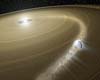 Pasadena CA (SPX) Jan 12, 2006
NASA's Spitzer Space Telescope has spotted what may be comet dust sprinkled around the white dwarf star G29-38, which died approximately 500 million years ago. |
|
|

| The content herein, unless otherwise known to be public domain, are Copyright 1995-2006 - SpaceDaily.AFP and UPI Wire Stories are copyright Agence France-Presse and United Press International. ESA PortalReports are copyright European Space Agency. All NASA sourced material is public domain. Additionalcopyrights may apply in whole or part to other bona fide parties. Advertising does not imply endorsement,agreement or approval of any opinions, statements or information provided by SpaceDaily on any Web page published or hosted by SpaceDaily. Privacy Statement |