|
 |
 |
 |
 |
 |
 |
 |
 |

 |
Lockheed Martin and General Atomics Demo Integrated Maritime Surveillance
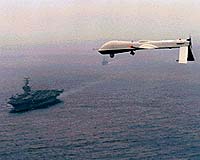
Washington (SPX) May 07, 2004 Lockheed Martin and General Atomics Aeronautical Systems, Inc. (GA-ASI) successfully demonstrated their low-cost, low-risk, highly capable solution for the U.S. Navy's Broad Area Maritime Surveillance (BAMS) unmanned aerial vehicle (UAV) program at a recent flight exercise in San Diego. US Navy, Coast Guard and Homeland Security officials observed the operation firsthand at Lockheed Martin's Global Vision Center (GVC) in San Diego or through a real-time secure webcast. The team's solution -- built around a proven, low-cost air vehicle system, established sensors and network communications capabilities -- is designed to expand the Navy's ability to conduct broad area maritime surveillance and provide persistent Intelligence, Surveillance and Reconnaissance (ISR). This flight was the first time that a 360-degree maritime surface search radar was demonstrated on a U.S. remotely piloted aircraft. The system is configured for an operator to direct the aircraft operating in an autonomous mode by point-and-click commands while simultaneously controlling the radar and day/night electro-optic video cameras. The Mariner demonstrator aircraft took off from GA-ASI's Flight Operations Facility in El Mirage, CA. Transiting via an IFR (instrument flight rules) flight plan in national air space, Mariner flew through the Los Angeles vicinity to the operating area off the coast of San Diego. Operator control was passed to the ground control station located at the GVC, where the Lockheed Martin and GA-ASI mission control system took over both the aircraft and its sensors, establishing Level 4 control. Level 4 control was demonstrated at the GVC and on the webcast using a Lockheed Martin Valiant display workstation, a next-generation variant of the AN/UYQ-70 (Q-70) program. Lockheed Martin Q-70 displays, controls and operating systems are widely used in U.S. Navy applications on sea, land, and airborne military platforms. The San Diego GVC is one node in a nationwide network developed by Lockheed Martin to demonstrate net-centric capabilities and interoperability with remote platforms, such as BAMS. All radar and video intelligence products were downlinked from the Mariner to the GVC while concurrently being simulcast on an encrypted Web site for worldwide observation. "This demonstration leverages capabilities Lockheed Martin has already developed and provides insight into the off-the-shelf ISR capabilities Lockheed Martin and General Atomics are prepared to deploy for the U.S. Navy," said Rick Ambrose, president of Lockheed Martin Maritime Systems & Sensors' Tactical Systems line of business. "The aircraft's sensors and mission system were integrated for this demonstration to highlight existing capabilities. Our total BAMS solution will include the Mariner high-endurance unmanned air vehicle, a customer-upgradeable mission control system and support throughout the life of the program." Thomas J. Cassidy, Jr., president and chief executive officer of General Atomics Aeronautical Systems, Inc., said, "In support of the Sea Power 21 vision, Lockheed Martin and GA-ASI will provide Mariner to the U.S. Navy BAMS program as the only low-risk aircraft system with joint commonality among our military forces. GA-ASI has successfully fielded the U.S. Air Force MQ-9 Hunter Killer Predator B aircraft for ISR and other operations, and we have optimized a version of this aircraft, the Mariner, for the Navy mission with a surface search radar and electronic sensors installed. With over 10 very successful years of UAV development and employment, our Mariner aircraft, along with Lockheed Martin's experience providing the U.S. Navy with maritime patrol aircraft and avionic mission system upgrades, offers the U.S. Navy the most effective solution for maritime surveillance." Prime contractor Lockheed Martin and GA-ASI teamed in August 2003 to pursue the U.S. Navy BAMS UAV program. Community Email This Article Comment On This Article Related Links Lockheed Martin General Atomics Aeronautical Systems SpaceDaily Search SpaceDaily Subscribe To SpaceDaily Express UAV News - Suppliers and Technology
 USAF UAV Battlelab Sponsors Demo Of Proxy Aviation's SkyForce
 Germantown MD (SPX) Jan 11, 2006
Proxy Aviation Systems recently announced the United States Air Force (USAF) Unmanned Aerial Vehicle Battlelab (UAVB) sponsored and cooperated in a demonstration of SkyForce, Proxy Aviation's unmanned aircraft system. |
|
|

| The content herein, unless otherwise known to be public domain, are Copyright 1995-2006 - SpaceDaily.AFP and UPI Wire Stories are copyright Agence France-Presse and United Press International. ESA PortalReports are copyright European Space Agency. All NASA sourced material is public domain. Additionalcopyrights may apply in whole or part to other bona fide parties. Advertising does not imply endorsement,agreement or approval of any opinions, statements or information provided by SpaceDaily on any Web page published or hosted by SpaceDaily. Privacy Statement |