|
 |
 |
 |
 |
 |
 |
 |
 |

 |
Lockheed Martin Wins Japanese Sea-Based Missile Defense Capability Contract
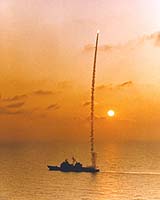
Moorestown, NJ (SPX) Jul 18, 2005 Lockheed Martin has been awarded a $124 million, three- year contract for Japanese Foreign Military Sales Aegis Ballistic Missile Defense (BMD) Weapon System engineering development. The contract provides the Aegis BMD Weapon System upgrades for the first of a planned group of four Japanese Kongo-class destroyers, DDG 173. Under the contract, Lockheed Martin is responsible for combat systems engineering, and development and integration of the Aegis BMD Weapon System, as well as upgrades to the Vertical Launching System and the ship Command and Control System. "Our continued work with the Japanese Maritime Self Defense Force underscores their trust in our ability to deliver the most capable and advanced missile defense capability," said Fred P. Moosally, president of Lockheed Martin's Maritime Systems & Sensors business unit. "The Aegis BMD Weapon System will become a vital component of Japan's strong and ready naval self-defense force." This FMS effort will be performed under the existing Aegis BMD contract awarded in October 2003. The work will be performed in Moorestown, NJ; Eagan, MN; and Baltimore, MD, and is expected to be complete in 2007. The Missile Defense Agency (MDA) and the U.S. Navy are jointly developing Aegis BMD as part of the Ballistic Missile Defense System (BMDS). The MDA and the U.S. Navy will ultimately outfit 15 Aegis destroyers and three Aegis cruisers with the capability to conduct Long Range Surveillance and Tracking (LRS&T) and engagement of ballistic missile threats using the Aegis BMD Weapon and its Standard Missile-3. The Aegis Weapon System is the world's premier naval surface defense system and is the basis for Aegis BMD, the primary component of the sea-based element of the United States' Ballistic Missile Defense System. The Aegis BMD Weapon System seamlessly integrates the SPY-1 radar, the Mk 41 Vertical Launching System and the SM-3 missile with its own command and control system. It is capable of simultaneous operation defending against advanced air, surface, subsurface and ballistic missile threats. The Aegis BMD Weapon System also integrates with the BMDS, providing cueing information to other BMDS elements today as well as providing and using more robust tracking information in the future to significantly expand national missile defense capability. Currently, Aegis Weapon System capabilities are on 69 U.S. Navy cruisers and destroyers on station around the world. Plans are currently underway to install the system on an additional 17 U.S. Navy destroyers. In addition to the U.S., Aegis is the weapon system of choice for Spain, Japan, Korea, and Norway. Recently, Australia selected Aegis for its new Air Warfare Destroyer program. Community Email This Article Comment On This Article Related Links Lockheed Martin SpaceDaily Search SpaceDaily Subscribe To SpaceDaily Express Learn about missile defense at SpaceWar.com Learn about nuclear weapons doctrine and defense at SpaceWar.com All about missiles at SpaceWar.com Learn about the Superpowers of the 21st Century at SpaceWar.com
 Missile Defense Program Moves Forward
 Washington DC (AFPS) Jan 12, 2006
The Missile Defense Agency continues to move forward in its efforts to protect the nation against a ballistic missile attack. The eighth ground-based interceptor missile was lowered into its underground silo at Fort Greely, Alaska, Dec. 18, 2005. |
|
|

| The content herein, unless otherwise known to be public domain, are Copyright 1995-2006 - SpaceDaily.AFP and UPI Wire Stories are copyright Agence France-Presse and United Press International. ESA PortalReports are copyright European Space Agency. All NASA sourced material is public domain. Additionalcopyrights may apply in whole or part to other bona fide parties. Advertising does not imply endorsement,agreement or approval of any opinions, statements or information provided by SpaceDaily on any Web page published or hosted by SpaceDaily. Privacy Statement |