|
 |
 |
 |
 |
 |
 |
 |
 |

 |
Lockheed Martin Scores Success With Landing Technology
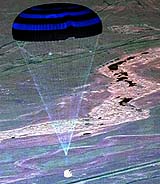
Farnborough UK (SPX) Jul 21, 2004 Lockheed Martin has successfully performed a series of drop tests at the U.S. Army Yuma Proving Ground in Yuma, Ariz., to validate soft landing technology that can be used for astronaut crew capsules upon return to Earth. The technology makes use of an array of dual airbags that, upon ground impact, releases air from the outer bags of the system, allowing the capsule to settle softly to the ground on its inner airbags. "This technology could be used in a number of ways, one of which would help ensure a safe landing for our astronauts in new crew exploration vehicles that are being considered for the future," said Michael Coats, vice president and deputy of Space Exploration at Lockheed Martin Space Systems. "These successful drop tests provide us and NASA with solid data on airbag and landing technology that could be very instrumental in future crew capsule systems. Whatever the requirements will be for a new crew vehicle, the safety of our astronauts continues to be the number one priority in every design we are considering." The drop tests were conducted June 24-25 under Lockheed Martin funding to demonstrate technology and risk reduction for space exploration. The 5,216 kg/11,500 lb capsule mass simulator was designed using the mass and center of gravity properties of astronaut crew capsules that are being considered for the future. During a series of tests, the capsule simulator was dropped from various heights and inclinations. The airbag system performed as expected with each impact, demonstrating that the modeling techniques were right on target. Instead of bouncing upon impact, the crew capsule mass simulator gently settled to Earth after each drop on a "pillow" of airbags. Instrumentation indicated that the short-duration deceleration forces would be very benign for both spacecraft and crewmembers. "Unlike the Apollo program that limited the capsules to water landings, the technology that we are testing today could allow a future crew exploration vehicle to safely return the crew to land, providing more flexibility in landing the crew and making it more affordable, as well," added Coats. Lockheed Martin will continue to test the airbag and landing technology, including future airborne drop tests, to demonstrate nominal and abort reentry capability. The tests utilize an airbag system provided by Irvin Aerospace of Anaheim, California. Community Email This Article Comment On This Article Related Links Lockheed Martin SpaceDaily Search SpaceDaily Subscribe To SpaceDaily Express Space Tourism, Space Transport and Space Exploration News
 Spicing Up Space Meals
 Los Angeles CA (SPX) Jan 04, 2006
Since its launch a year and half ago, Minimus.biz has quickly become the place to go for individual and travel size items. Last week, NASA came to Minimus.biz and purchased several different travel size condiments to send with the astronauts to the International Space Station. |
|
|

| The content herein, unless otherwise known to be public domain, are Copyright 1995-2006 - SpaceDaily.AFP and UPI Wire Stories are copyright Agence France-Presse and United Press International. ESA PortalReports are copyright European Space Agency. All NASA sourced material is public domain. Additionalcopyrights may apply in whole or part to other bona fide parties. Advertising does not imply endorsement,agreement or approval of any opinions, statements or information provided by SpaceDaily on any Web page published or hosted by SpaceDaily. Privacy Statement |