|
 |
 |
 |
 |
 |
 |
 |
 |

 |
Lockheed Martin Scientists Determine Magnetic Reconnection Locations At Earth's Magnetopause
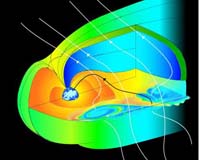
Palo Alto CA (SPX) Feb 20, 2007 In a paper published in the February 2007 issue of Geophysical Research Letters, scientists from the Lockheed Martin Advanced Technology Center (ATC) are using data from a unique, state-of-the-art scientific instrument - designed and built at the Palo Alto facility - to determine how and where the energy from the solar wind is transferred into the Earth's magnetosphere. This transfer of energy causes auroras and also affects radio communications, satellite operations and electric power systems on Earth. The process is called magnetic reconnection and occurs when magnetic fields from different domains - in this case, from the Interplanetary Magnetic Field (IMF) carried by the solar wind, and the Earth's magnetic field - are spliced together, allowing the transfer of energy from one domain to the other. The magnetopause defines the boundary between the Earth's field and the solar wind. It has a bullet-shaped front, gradually changing into a cylinder as it envelopes the planet and trails off behind where it is called the magnetotail. Reconnection breaks through the protection afforded by this natural magnetic sheath, allowing charged particles and energy from the Sun to enter the space around Earth. "We have found in our study of 130 reconnection events that, in general, magnetic reconnection occurs along an extended line across the dayside magnetopause," said Dr. Karlheinz Trattner, Lockheed Martin space plasma physicist at the ATC. "Previously, there was considerable debate concerning the nature of this reconnection line. Some scientists believed that this reconnection line was not continuous across the dayside magnetopause, while others thought it was. The results from this study have resolved this long-standing debate." The data leading to this discovery came from the "Toroidal Imaging Mass Angle Spectrograph" (TIMAS), an ATC instrument launched on the NASA Polar spacecraft in 1996. By measuring the angle, mass and energy of the ions in space plasmas, in all directions simultaneously, TIMAS has helped Trattner's team understand how the ions behave in the magnetic field that fills space around Earth. From those deductions the scientists are able to track the ions back in space and time to determine where they originated and how they were transported. An ion is a special kind of atom -- one that has lost one or more of the electrons that orbit the atom's nucleus. The loss of an electron gives an ion an electrical charge and -- unlike a neutral particle that has all its electrons and therefore no electric charge -- causes it to react to magnetic and electric fields. Clouds of ions and electrons are called plasmas. While an atom of any substance can be ionized, those that are most commonly found in Earth's magnetosphere range from hydrogen (the lightest) to oxygen (the heaviest). To understand where plasmas come from, scientists must be able to measure the relative abundances of the ions they contain and then compare them with the known abundances in potential source regions. TIMAS provides that capability. While earlier instruments were able to measure species of ions one or two at a time, TIMAS simultaneously senses all important ion species in the magnetosphere from hydrogen to oxygen. TIMAS looks in all directions at once to detect the species, measure their mass, the angle at which they arrive at the instrument, and their energy. Community Email This Article Comment On This Article Related Links Lockheed Martin Solar Science News at SpaceDaily Solar Science News at SpaceDaily
 Cluster New Insights Into The Electric Circuits Of Polar Lights
 Stockholm, Sweden (SPX) Feb 12, 2007
Giant electrical circuits power the magical open-air light show of the auroras, forming arcs in high-latitude regions like Scandinavia. New results obtained thanks to ESA's Cluster satellites provide a new insight into the source of the difference between the two types of electrical circuits currently known to be associated to the auroral arcs. |
|
|

| The content herein, unless otherwise known to be public domain, are Copyright 1995-2006 - SpaceDaily.AFP and UPI Wire Stories are copyright Agence France-Presse and United Press International. ESA PortalReports are copyright European Space Agency. All NASA sourced material is public domain. Additionalcopyrights may apply in whole or part to other bona fide parties. Advertising does not imply endorsement,agreement or approval of any opinions, statements or information provided by SpaceDaily on any Web page published or hosted by SpaceDaily. Privacy Statement |