|
 |
 |
 |
 |
 |
 |
 |
 |

 |
Lockheed Martin Receives Airborne Laser Turret Ball From Brashear
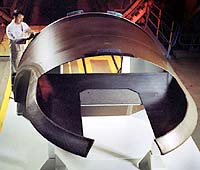
Sunnyvale CA (SPX) May 17, 2004 Lockheed Martin said Thursday that it has begun final integration of the flight turret assembly for the Airborne Laser (ABL) program. ABL will be the world's first megawatt-class laser weapon system integrated on a specially configured 747-400F aircraft to autonomously detect, track and destroy hostile ballistic missiles. Lockheed Martin is responsible for the system that will accurately point, focus and fire the laser to provide sufficient energy to destroy the missile while it is still in the highly vulnerable boost phase of flight -- before separation of its warheads. The ABL program is managed by the Missile Defense Agency and is executed by the U.S. Air Force from Kirtland Air Force Base in Albuquerque, N.M. With the arrival of the flight turret ball from subcontractor Brashear LP, Pittsburgh, on Tuesday, Lockheed Martin began integrating the turret ball into the Flight Turret Assembly (FTA), which will allow the turret ball to precisely yaw and roll in flight. The FTA -- the flight turret ball complete with a 1.5-meter telescope/beam director, and the lightweight composite roll shell structure -- is what visually distinguishes the ABL aircraft from any other 747. It is the distinctive "nose" of the aircraft from which the high-energy laser will be "fired" at threat missiles. The flight ball completion is the culmination of a six-year development effort, during which time the program stabilized the supplier base for large optics and high-performance coatings. Among the key contributors to the flight ball were: Brashear LP, as the telescope lead and integrator; Corning, providing the rough-finished primary mirror for the 1.5 meter telescope and conformal window; Heraeus, providing the glass; Optical Coating Laboratory, Inc., coating the conformal window; Applied Aerospace Structures Corp., providing the ball structure and gimbal ring; Composite Optics, Inc., providing the telescope metering structure; and Barr, coating the small optics. The conformal window, the large piece of glass on the forward side of the turret ball, is one of the largest transmissive optics ever coated. Both the manufacture of the optic and coating of it involved the artful application of science, with glass shaped to exacting specifications to prevent beam distortion, and coated in such a way as to ensure that the high-energy laser isn't reflected and absorbed within the ball while allowing the laser energy to pass through to the intended target. "The completion of the turret ball required close cooperation among a highly specialized industrial team spread across nine time zones. This significant accomplishment would not have been possible without the commitment and concentrated work from the staff at Brashear," said Paul Shattuck, ABL technical director, Lockheed Martin Space Systems. Lockheed Martin plans to deliver the complete turret assembly to ABL contractor-lead Boeing at Edwards Air Force Base, Calif., late this summer. "Airborne Laser has been a key program for Brashear LP, enabling the company to grow significantly over the last seven years," said Brashear LP Chief Executive Officer Bill Conway. "We are proud to be a member of this team." Boeing, Lockheed Martin and Northrop Grumman, working closely with the Air Force and the Missile Defense Agency, are developing ABL. Boeing is responsible for developing the ABL battle management system, integrating the weapon system, and supplying the modified 747-400 freighter aircraft. Lockheed Martin is developing the Beam Control/Fire Control system. Northrop Grumman is providing the complete chemical oxygen iodine high-energy laser system. Lockheed Martin is a world leader in systems integration and the development of air and missile defense systems and technologies. These include the world's first successful hit-to-kill intercept with the Homing Overlay Experiment in 1984, the successful demonstration of the first complete weapon system using hit-to-kill technology with the Terminal High Altitude Area Defense (THAAD), as well as the world's first operational hit-to-kill missile defense system, PAC-3. Community Email This Article Comment On This Article Related Links Lockheed Martin SpaceDaily Search SpaceDaily Subscribe To SpaceDaily Express Learn about laser weapon technology at SpaceWar.com
 Northrop Grumman Wins Contrct To Maintain The "Rayguns"
 Mclean VA (SPX) Mar 01, 2005
The U.S. Army Space and Missile Defense Command has awarded Northrop Grumman Corporation a follow-on contract for operations and maintenance of lasers and facility-support systems used to test the effects of lasers against physical threats. |
|
|

| The content herein, unless otherwise known to be public domain, are Copyright 1995-2006 - SpaceDaily.AFP and UPI Wire Stories are copyright Agence France-Presse and United Press International. ESA PortalReports are copyright European Space Agency. All NASA sourced material is public domain. Additionalcopyrights may apply in whole or part to other bona fide parties. Advertising does not imply endorsement,agreement or approval of any opinions, statements or information provided by SpaceDaily on any Web page published or hosted by SpaceDaily. Privacy Statement |