
 |
 |
 |
 |
 |
 |
 |
 |
 |

 |
Lockheed Martin Program Director Inducted Into GPS Hall Of Fame
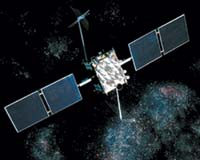
Newtown PA (SPX) Jun 17, 2008 David J. Podlesney, a 34-year Lockheed Martin employee, was inducted into the Global Positioning System (GPS) Hall of Fame for 2008 during a May 21 ceremony in Long Beach, Calif. The Global Positioning Systems Wing of the U.S. Air Force Space and Missile Systems Center, Los Angeles Air Force Base, Calif. established the GPS Hall of Fame in 1995 to recognize individuals who have made lasting contributions to the worldwide system. Previous honorees include GPS co-inventors Dr. Bradford W. Parkinson and the late Ivan Getting. Podlesney was selected for this prestigious award for his outstanding engineering leadership and technical performance leading to the delivery, successful launch, and record-setting handover of the first modernized GPS satellite. He was also cited for his role on several other achievements which include early fielding of the new L2C and M-code signals years in advance, allowing the warfighter and civilian users to benefit from early access; implementing an L5 demonstration capability for the GPS Wing one year after contract award; and launching 18 GPS IIR/IIR-M space vehicles to date that are providing superior navigation performance. "We are proud to have Dave on our team and we congratulate him on being inducted into the GPS Hall of Fame," said Rick Ambrose, vice president and general manager of Surveillance and Navigation Systems for Lockheed Martin. Lockheed Martin Space Systems, Valley Forge, Pa., and its navigation payload provider ITT of Clifton, N.J. designed and built 21 GPS IIR satellites for the Air Force and subsequently modernized eight of those spacecraft, designated IIR-M, to enhance operations and navigation signal performance. Work on the final IIR-M satellite, which features the new L5 signal, was completed in March and is planned for launch this year from Cape Canaveral. "I have always felt extremely fortunate to be a member of this great team and to work on a program that is vitally important to our military and civilian users around the globe," said Podlesney, who joined the GPS IIR program in 1992 as chief engineer and became the GPS IIR/IIR-M program manager in 2000. "To be selected to join the GPS Hall of Fame is truly a privilege." The GPS constellation provides critical situational awareness and precision weapon guidance for the military. The worldwide system also supports a wide range of civil, scientific and commercial functions -- from air traffic control to the Internet -- with precision location and timing information. Podlesney will also serve as Lockheed Martin's program director for the U.S. Air Force's next-generation Global Positioning System Space System program, known as GPS III. This program will improve position, navigation, and timing services for the warfighter and civil users worldwide and provide advanced anti-jam capabilities yielding superior system security, accuracy and reliability. Community Email This Article Comment On This Article Share This Article With Planet Earth
Related Links the missing link GPS Applications, Technology and Suppliers
 GeoSpot Deep Local Search And Exploration Goes Mobile
 Fremont CA (SPX) Jun 17, 2008
GeoSpot has announced a Beta release of GeoSpot Mobile Web service. The service is a patent-pending high-performance sweeping search of local businesses and other POIs (points of interest) that are open either now or at a specified time. |
|
|

| The content herein, unless otherwise known to be public domain, are Copyright 1995-2007 - SpaceDaily.AFP and UPI Wire Stories are copyright Agence France-Presse and United Press International. ESA Portal Reports are copyright European Space Agency. All NASA sourced material is public domain. Additional copyrights may apply in whole or part to other bona fide parties. Advertising does not imply endorsement,agreement or approval of any opinions, statements or information provided by SpaceDaily on any Web page published or hosted by SpaceDaily. Privacy Statement |
 del.icio.us
 Digg
Digg Reddit
 YahooMyWeb
 Google
 Facebook