|
 |
 |
 |
 |
 |
 |
 |
 |

 |
Lockheed Martin Hinode Findings Explain What Powers The Solar Wind
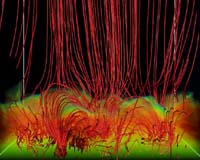
Palo Alto CA (SPX) Dec 12, 2007 In a paper published in the journal Science, researchers -- from the Solar and Astrophysics Laboratory (LMSAL) of the Lockheed Martin Advanced Technology Center (ATC), along with colleagues at other institutions in Colorado, Norway and Japan -- have described new observations from NASA's Focal Plane Package for the Solar Optical Telescope (SOT) on the Japanese Hinode satellite that provide further insight into the mechanisms that generate the solar wind. For years, many solar physicists have believed that Alfven waves -- created from convective motions and acoustic energy jostling solar magnetic fields -- were most likely the force powering the solar wind. But before the SOT on Hinode, the resolution of solar instruments was not sufficient to resolve the mystery. "The high spatial and temporal resolution of SOT -- imaging solar structure just 150 km across every five seconds -- enabled us to resolve, for the first time, the predicted amplitudes of the Alfven waves, as well as some of the dominant spatial and temporal scales of the chromosphere -- the region sandwiched between the solar surface and the sun's atmosphere or corona," said Dr. Bart De Pontieu, a solar physicist at LMSAL who led the research team that produced the results reported in Science. "We found that the chromosphere is permeated with Alfven waves that are energetic enough to accelerate the solar wind." It was the behavior of spicules in the sun's chromosphere -- waving from side to side like a field of wheat in a gentle breeze -- which heralded the presence of the elusive Alfven waves in the SOT images. Spicules are jets of gas or plasma propelled upwards from the surface, shooting into the atmosphere at supersonic speeds of 100,000 miles per hour, and reaching heights of 5,000 miles above the solar surface in less than five minutes. Spicules outline the direction of the sun's magnetic field, so that their oscillations indicate the passage of Alfvenic wave motions. "Most of the Alfven waves we observe have periods of several minutes, much longer than many theoretical models have assumed in the past," said Dr. Scott McIntosh, a solar physicist at Southwest Research Institute in Boulder, Colorado. Additionally, the team used high fidelity computer simulations to investigate how the waves are generated. "Our simulations imply that it is the bumping and jostling of the magnetic fields in the lower atmosphere that is driving these Alfven waves, which then impart their energy to the solar wind," said Prof. Mats Carlsson of the Institute of Theoretical Astrophysics at the University of Oslo, Norway. These findings, along with several other reports, appear in a special issue of Science that features the latest scientific findings from Hinode, an international mission led by Japan to study the sun's magnetic field and how its explosive energy propagates through the different layers of the solar atmosphere. Hinode is a collaborative mission among the space agencies of Japan, the United States, the United Kingdom, Norway and Europe, and Japan's National Astronomical Observatory. NASA's Marshall Space Flight Center manages science operations and managed the development of the scientific instrumentation provided for the mission by NASA, industry and other federal agencies. Lockheed Martin's Advanced Technology Center is the lead U.S. investigator for the Solar Optical Telescope. The Solar and Astrophysics Laboratory at the ATC has a 44-year-long heritage of spaceborne solar instruments including the Soft X-ray Telescope on the Japanese Yohkoh satellite, the Michelson Doppler Imager on the ESA/NASA Solar and Heliospheric Observatory, the solar telescope on NASA's Transition Region and Coronal Explorer, the Solar X-ray Imager on the GOES-N environmental satellite, the Focal Plane Package on Hinode, an Extreme Ultraviolet Imager on each of the two spacecraft in NASA's Solar Terrestrial Relations Observatory and two instruments on NASA's Solar Dynamics Observatory slated for launch in 2008. The laboratory also conducts basic research into understanding and predicting space weather and the behavior of the Sun including its impacts on Earth and climate. The ATC is the research and development organization of Lockheed Martin Space Systems Company (LMSSC). LMSSC, a major operating unit of Lockheed Martin Corporation, designs, develops, tests, manufactures and operates a full spectrum of advanced-technology systems for national security, civil and commercial customers. Chief products include human space flight systems; a full range of remote sensing, navigation, meteorological and communications satellites and instruments; space observatories and interplanetary spacecraft; laser radar; fleet ballistic missiles; and missile defense systems. Community Email This Article Comment On This Article Related Links Solar Science News at SpaceDaily
 Closing In On A Hot Solar Science Mystery Story
 Greenbelt MD (SPX) Dec 07, 2007
Imagine you are sitting around a campfire. Move closer to the fire, and you get hotter. Move away, and you get cooler. Pretty basic, right? Well, the closest star, our sun, doesn't seem to be getting this. As you move away from the solar surface, into the sun's outer atmosphere, the corona, it actually gets a lot hotter before it cools off. The solar surface is about 10,000 degrees Fahrenheit, while temperatures in the corona soar to millions of degrees. |
|
|

| The content herein, unless otherwise known to be public domain, are Copyright 1995-2007 - SpaceDaily.AFP and UPI Wire Stories are copyright Agence France-Presse and United Press International. ESA Portal Reports are copyright European Space Agency. All NASA sourced material is public domain. Additional copyrights may apply in whole or part to other bona fide parties. Advertising does not imply endorsement,agreement or approval of any opinions, statements or information provided by SpaceDaily on any Web page published or hosted by SpaceDaily. Privacy Statement |