|
 |
 |
 |
 |
 |
 |
 |
 |

 |
Lockheed Martin Develops New Imaging Technology For Space Telescopes
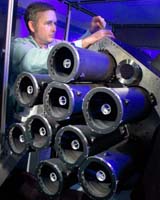
Palo Alto CA (SPX) Jun 28, 2006 Engineers at Lockheed Martin's Advanced Technology Center have designed and built a prototype nine-aperture wide-field imaging telescope the company said overcomes the increase in mass, volume and cost associated with large single-optics telescopes for space-based applications. The ATC prototype, called Star-9 - because of the number and arrangement of its apertures - uses multiple small telescopes that yield the same resolution as a much larger single aperture instrument. This distributed-aperture imaging approach provides a new path to affordable high resolution, LM said in a news release, by packaging the modules in a smaller envelope thus reducing the size, weight and cost of the system. The ability of a telescope to resolve fine detail is a direct function of its light-gathering power. Larger apertures - mirrors or lenses - gather more light and provide greater resolution of detail. Multiple apertures, however, provide a multi-functional capability unavailable with a single mirror. A distributed-aperture approach could be incorporated in space-based remote sensing instruments that might use individual telescope modules, or groups of modules, to view a scene at several different wavelengths or polarizations simultaneously. Software can reconfigure the system on subsequent orbits to make completely different sets of observations. It also can group some of the separate apertures as a sub-array to image multiple objects on a single pass. The Star-9 telescope could easily serve as the imaging front end for an entire suite of space-based instruments, the LM release said. In addition, the technology provides redundancy, reliability and thus lower-risk, because a failure in a monolithic mirror system could doom a mission, while the loss of a single aperture in a multiple-aperture system can be overcome by reconfiguring the system. The ATC has been conducting Star-9 performance demonstrations using off-the-shelf focal planes, electronics and mirror actuators. The experiments show clearly, the LM release said, "that high-quality imagery can be acquired over a useful field of view for an Earth-imaging or an astronomical-distributed-aperture imaging system." "The key to making a distributed aperture optical system work is to properly phase the individual modules. Phasing means that all telescopes present an equal path length, to tolerances considerably less than the wavelength of light," said Peter Dean, the Star-9 program manager at the ATC. "We have demonstrated the fundamental feasibility of this approach with the Star-9 test bed and quantified performance with subsequent test bed activities," Dean added. Community Email This Article Comment On This Article Related Links Lockheed Martin Space Telescope News and Technology at Skynightly.com
 NASA Updates Hubble Status
 Washington DC (SPX) Jun 28, 2006
NASA announced Tuesday that its engineers are continuing to study the problem related to the Hubble Space Telescope's Advanced Camera for Surveys. Engineers first received indications on June 19 that the power supply voltages had fallen below acceptable operational limits, which caused the camera to switch automatically into a safe mode - and to stop operating. |
|
|

| The content herein, unless otherwise known to be public domain, are Copyright 1995-2006 - SpaceDaily.AFP and UPI Wire Stories are copyright Agence France-Presse and United Press International. ESA PortalReports are copyright European Space Agency. All NASA sourced material is public domain. Additionalcopyrights may apply in whole or part to other bona fide parties. Advertising does not imply endorsement,agreement or approval of any opinions, statements or information provided by SpaceDaily on any Web page published or hosted by SpaceDaily. Privacy Statement |