|
 |
 |
 |
 |
 |
 |
 |
 |

 |
Lockheed Martin-Built DSCS Satellites Mark 175 Years On Orbit
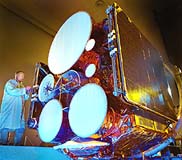
Sunnyvale CA (SPX) Nov 22, 2006 A U.S. Air Force/Lockheed Martin team have announced that the Defense Satellite Communications System (DSCS) III constellation, which provides vital communications capabilities to America's military forces worldwide, has surpassed 175-years of on-orbit service. The DSCS constellation, which includes nine active satellites in geostationary orbit, provides uninterrupted secure voice and high-data rate communications to Department of Defense and other government users, essential tools in monitoring events and deploying and sustaining forces anywhere in the world. Each DSCS III satellite has a design life of 10-years, although several of the DSCS satellites on-orbit today have far exceeded their design life and continue to perform with outstanding results. The DSCS team was recently named a winner of the 2006 Chief of Staff Team Excellence Award by the U.S. Air Force for developing innovative methods for estimating and maximizing the fuel on board the DSCS satellite constellation. "We are very proud of the DSCS program's impressive record of performance and longevity," said Leonard F. Kwiatkowski, vice president and general manager of Military Space Programs at Lockheed Martin Space Systems Company. "DSCS has served as the backbone of military communications capabilities and will continue to play a pivotal role on our national security for many years to come." Lockheed Martin Space Systems, Sunnyvale, Calif., is the prime contractor for the DSCS III program. The company designed and built 14 DSCS spacecraft for the Military Satellite Communications Systems Wing at the Air Force's Space and Missile Systems Center, Los Angeles, Calif. The final four spacecraft featured Service Life Enhancement Program (SLEP) upgrades designed to provide users with improved and uninterrupted secure voice and high data rate communications. The last satellite was successfully launched on August 29, 2003. Lockheed Martin is also progressing on the Department of Defense's highly secure communications satellite system known as the Advanced Extremely High Frequency (AEHF) system, with development of the first AEHF satellite proceeding on schedule towards an April 2008 launch. AEHF is the successor to the Lockheed Martin-built Milstar secure communications system which has reached 36 years of combined successful operations on-orbit. The company is leveraging its proven record of building advanced military communications systems for the next-generation Transformational Satellite Communications System (TSAT), which will ultimately replace the DSCS, Milstar and Advanced EHF programs. The Lockheed Martin/Northrop Grumman TSAT Space Segment team is currently working under a Risk Reduction and System Definition phase, with the Air Force expected to award a multi-billion dollar development contract to a single contractor in 2008. Community Email This Article Comment On This Article Related Links Lockheed Martin Read the latest in Military Space Communications Technology at SpaceWar.com Read the latest in Military Space Communications Technology at SpaceWar.com
 III MEF Units Transition To New Mobile Communications System
 Camp Foster, Japan (SPX) Nov 22, 2006
Nearly 50 Marines from communication units throughout III Marine Expeditionary Force learned the ins and outs of an advanced field communications system recently during a month-long training evolution at the Marine Wing Communication 18 Maintenance Facility on Camp Foster. |
|
|

| The content herein, unless otherwise known to be public domain, are Copyright 1995-2006 - SpaceDaily.AFP and UPI Wire Stories are copyright Agence France-Presse and United Press International. ESA PortalReports are copyright European Space Agency. All NASA sourced material is public domain. Additionalcopyrights may apply in whole or part to other bona fide parties. Advertising does not imply endorsement,agreement or approval of any opinions, statements or information provided by SpaceDaily on any Web page published or hosted by SpaceDaily. Privacy Statement |