|
 |
 |
 |
 |
 |
 |
 |
 |

 |
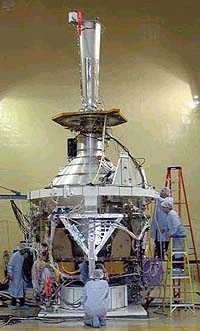
Lockheed Martin-Built Gravity Probe B Spacecraft Readied For Launch
Sunnyvale - Apr 02, 2004 NASA's Gravity Probe B (GP-B) space vehicle, built, integrated and tested by Lockheed Martin Corporation at its Space Systems Company facility in Sunnyvale, Calif., is sitting atop a Delta II rocket at Vandenberg Air Force Base, Calif., undergoing final preparations for launch on April 17, 2004. Stanford University is the GP-B prime contractor. NASA Marshall Space Flight Center in Huntsville, Ala. Manages the program. During its 16-month mission, GP-B will attempt to verify two subtle physical effects predicted by Albert Einstein's General Theory of Relativity, which provides the foundations for understanding the large-scale structure of the Universe. "We're now counting the days until launch and are enormously proud of the close collaboration with our Stanford and NASA colleagues that has brought us to this exciting point in the GP-B program," said Jim Crocker, vice president, civil space, Lockheed Martin Space Systems Company. "We look forward to the mission ahead and the data that will increase our understanding of the fundamental structure of the universe." "Developing GP-B has been a supreme challenge requiring the skillful integration of an extraordinary range of new technologies," said Professor Francis Everitt of Stanford University, and the GP-B principal investigator. "It is hard to see how it could have been done without the kind of unique long-term collaboration that we have had between Stanford, Lockheed Martin and NASA." It is wonderful to be ready for launch." The GP-B space vehicle comprises the spacecraft, built by Space Systems, and its payload. The payload is made up of the dewar, the key structural component around which the GP-B space vehicle was built, and the flight probe, a nine-foot-long cigar-shaped vacuum chamber. Both elements were built at the Lockheed Martin Advanced Technology Center (ATC) in Palo Alto. Inside the flight probe is the very delicate and precise Science Instrument Assembly, built by Stanford University. The requirements of the GP-B experiment for stability and freedom from outside forces are extremely demanding. The ATC team provided Stanford an enclosure within which the scientific instrument can operate at a temperature near absolute zero, and in a pressure 10 times lower than the vacuum pressure in space in which the spacecraft will be flying. The magnetic field at the Science Instrument Assembly is less than one millionth of the Earth's magnetic field and the science gyroscopes inside the probe will operate in a very quiet, low acceleration environment. The Science Instrument Assembly is simple in its concept: A block of fused quartz 21-inches long, with a bonded quartz telescope on one end, holds four gyroscopes. SQUIDs, which are very sensitive magnetometers, provide the gyroscope readouts. The gyro-telescope instrument is held in the flight probe, which is inserted into the dewar, an extremely complicated Thermos-like bottle. The dewar holds 613 gallons of superfluid, supercold helium, which will keep the instrument chilled to about 2 Kelvin (-455 degrees Fahrenheit) for the duration of the mission. When Gravity Probe B is launched into a 400-mile-high polar orbit, the instrument apparatus will measure tiny changes in spin axis orientation of the four ultra-precise gyroscopes contained within. The gyros will be so free of disturbances that they will provide a nearly perfect space-time reference system. They are referenced to the science telescope that will sight on a far-field highly stable reference star. The principle behind the Gravity Probe B measurement is that ideal rotating gyroscopes, free of disturbing forces, always point in the same direction in inertial space. But this principle is where Dr. Einstein and Sir Isaac Newton differ. In Newton's physics, a perfect gyroscope pointed at a star should stay aligned forever. In Einstein's physics, the direction of the spin axis of the gyroscope will gradually change due to the mass and rotation of the Earth by an amount that can be exactly predicted. The gyroscopes will measure whether and how space and time are warped by the presence of Earth, and whether and how the rotating Earth drags space-time around with it. Relativists call the first of the two Einstein effects the "geodetic effect." The second is called the "frame-dragging effect." Each is minute but the gyroscopes are expected to determine frame-dragging to an accuracy of better than one percent, and the geodetic effect to a few parts in a hundred thousand. This will be by far the most accurate test of any of the predicted effects of Einstein's theory. Small as the two effects measured by Gravity Probe B are, their measurement will provide an extremely important advance by testing previously unproven predictions of Einstein's theory. They may provide critical clues to modern attempts to unify the four fundamental forces observed in Nature: electromagnetism, gravity, and the so-called strong and weak interactions that govern the behavior of atomic nuclei. "Gravity Probe B is one of the few space missions NASA has conducted with relevance to fundamental physics," stated a review of GP-B undertaken in 1995 by the Space Studies Board of the National Research Council. "If successful, it would assuredly join the ranks of the classical experiments of physics. By the same token, a confirmed result in disagreement with General Relativity would be revolutionary." Community Email This Article Comment On This Article Related Links Lockheed Martin Space Systems SpaceDaily Search SpaceDaily Subscribe To SpaceDaily Express Space Technology News - Applications and Research
 Industry Team Achieve New Communications Technology With AESA Radars
 Baltimore MD (SPX) Jan 12, 2006
A team comprised of three leading US aerospace and defense contractors has demonstrated an innovative technological use of active electronically scanned array (AESA) radars for high-bandwidth communications. |
|
|

| The content herein, unless otherwise known to be public domain, are Copyright 1995-2006 - SpaceDaily.AFP and UPI Wire Stories are copyright Agence France-Presse and United Press International. ESA PortalReports are copyright European Space Agency. All NASA sourced material is public domain. Additionalcopyrights may apply in whole or part to other bona fide parties. Advertising does not imply endorsement,agreement or approval of any opinions, statements or information provided by SpaceDaily on any Web page published or hosted by SpaceDaily. Privacy Statement |