|
 |
 |
 |
 |
 |
 |
 |
 |

 |
Listening To Vega
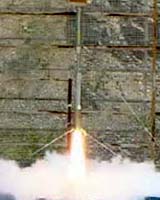
Colleferro (SPX) Jul 08, 2004 On a humid day in June, with a temperature similar to that at Europe's Spaceport in French Guiana, the engine of a miniature Vega launcher was ignited at Colleferro, a small town in the middle of Italy. The reason: to test the noise level.
Why Colleferro? Colleferro is where most of the work is being done to prepare Vega for launch in 2006. Vega, ESA's new 'baby' European launcher, is the smallest launcher to be developed by ESA.
Acoustic tests If this level is exceeded the vibration created by the noise of the engine during liftoff could damage the launcher components and the payload. To date, five of the eight tests scheduled to find the best configuration at the launch pad have been completed. These use a 1:20 scale model of Vega and its launch pad to simulate conditions at liftoff. Once everything is ready the scaled model of the a P80 solid rocket motor is ignited for two seconds, sufficient for the 42 microphones studded around the Vega model to measure the acoustic level. Cristiano Contini, an ELV engineer working on the Vega project says, "the noise level using the scale model is actually the same as it will be with a full-scale Vega, although the frequency level at a real launch will be about 20 times lower". A launch is always noisy as powerful engines are needed to raise a launcher off the ground. To reduce the noise to an acceptable level 'noise dampers' can be introduced such as:
Trials carried out so far include tests with the conduits both covered and uncovered, and tests with different amounts of water poured on to the launch pad. During some trials the Vega model is on the launch pad while during other tests 'Vega' is suspended 75 metres above the pad to simulate conditions immediately after launch. The aim is to find the most appropriate configuration on the pad in relation to the phenomena that occur during ignition, and to assess the expected levels during the early phases of the flight. These tests are an important step towards ensuring a successful launch for Vega and its payload. Says Avio engineer Flavia Mascanzoni, "a too high acoustic level creates too much vibration. This could damage the equipment inside the interstages, as well as the satellite's electronics and solar panels." Cristiano Contini added, "What we are trying to achieve is a reduction of around 5 decibels between the best and the worst launch pad configuration, as we want to be certain that the noise level complies with that specified in the launcher's design". Although noise is an important source of perturbation, other factors also have to be taken into consideration such as the blast wave, overpressure and thermal fluxes. The combination of all these has to be assessed to define the requirements that the launch vehicle should sustain and to decide what is the most suitable configuration on the launch pad to reduce the impact on the launcher at liftoff.
Next step The next step - the final decision on the launch pad configuration - is expected at the end of July, as soon as the results of all the tests have been analysed. Community Email This Article Comment On This Article Related Links Vega at ESA SpaceDaily Search SpaceDaily Subscribe To SpaceDaily Express Rocket Science News at Space-Travel.Com
 Successful First Test For Vega's Zefiro 9 Engine
 Paris, France(ESA) Dec 28, 2005
Flames, smoke and a deafening noise accompanied the first firing test of Vega's Zefiro 9 third-stage solid rocket motor. A first examination of the data indicates that everything went well at the test carried out yesterday at Salto de Quirra in southeast Sardinia. |
|
|

| The content herein, unless otherwise known to be public domain, are Copyright 1995-2006 - SpaceDaily.AFP and UPI Wire Stories are copyright Agence France-Presse and United Press International. ESA PortalReports are copyright European Space Agency. All NASA sourced material is public domain. Additionalcopyrights may apply in whole or part to other bona fide parties. Advertising does not imply endorsement,agreement or approval of any opinions, statements or information provided by SpaceDaily on any Web page published or hosted by SpaceDaily. Privacy Statement |