|
 |
 |
 |
 |
 |
 |
 |
 |

 |
Light That Candle We've Got Work To Do In Orbit
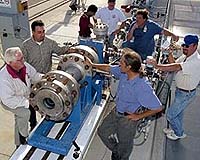
Huntsville - Jan 30, 2003 Waiting inside his Mercury capsule for the command that would start the countdown and make him the first American in space, Alan Shepard yelled impatiently, "Let's light this candle!" Those words may turn out to be more prophetic than Shepard intended. Since 2001, NASA's Ames Research Center has been testing a new rocket fuel made from--believe it or not--candle wax. "We actually ordered the wax for our test firings through a commercial Web site that sells candle wax in bulk," says Arif Karabeyoglu, who developed the theory behind paraffin-based rocket fuels and is currently a research associate at Stanford University. "We use the exact same wax found in 'hurricane' candles," he says. Safer to handle and better for the environment than today's solid rocket fuels, this modern twist on an ancient fuel could someday propel sounding rockets and commercial-payload rockets into space. It could even form the heart of a new generation of shuttle solid rocket boosters (SRBs) that would have a key safety feature today's SRBs lack: an "off" switch. This may seem a shockingly primitive fuel for 21st Century rocket technology. After all, humans have been burning candles (today often made of "paraffin" wax) for the last five millennia. Why didn't someone think of using it for rockets before? As anyone who's lit a candle knows, paraffin normally burns quite calmly, and it's difficult to make it burn at all without a wick. By all appearances, it just wasn't the kind of high-powered, explosive fuel needed to blast a rocket off of the planet! Working in collaboration with David Altman, currently president of Space Propulsion Group, and Brian Cantwell, a professor at Stanford, Karabeyoglu figured out a way to make paraffin burn three times faster than had ever been achieved before--fast enough to serve as rocket fuel. In their design, the paraffin burns in the presence of pure oxygen gas. This alone causes it to burn much hotter than it does in air, which is only about 21% oxygen. That much had been done before. Karabeyoglu's innovation was to blow the oxygen past the melted surface of the paraffin fast enough to "whip up" this surface, like the ocean's choppy surface on a windy day. The "sea spray" of paraffin droplets that this kicks up burns very rapidly, tripling the combustion rate of the fuel. More than 40 test firings by the Stanford-Ames collaborative project have shown that the idea works as advertised. That's good news for the rocket industry, because this paraffin fuel would be much simpler and safer to work with than the toxic, explosive fuels used today. Just think of a household candle. You can safely carve it, melt it, and mold it. If it's free from artificial colors or perfumes, you could even lick it or chew on it. You could burn dozens of them in a room with no fear of toxic gases making you sick. Don't try any of these things with conventional solid rocket fuels! One reason for the benign nature of candle wax is that the oxidizer needed for it to burn is separate from the wax itself: air in the case of candles, and pure oxygen for rockets. (Chemically speaking, combustion is the rapid "oxidation" of the fuel, usually by combining with the oxygen gas in the air. That's why fires go out when deprived of air.) This kind of rocket with a solid fuel and a separate gaseous or liquid oxidizer is called a "hybrid" rocket. In contrast, today's solid-fuel rockets use solid materials such as perchlorate compounds as oxidizers, and the fuel and oxidizer are mixed together before being packed into the rocket. In other words, the fuel is "charged" and ready to explode ... not a friendly material to work with. It's not friendly for the environment either. When today's solid fuels burn, they produce toxic compounds such as aluminum oxides and acidic gases like hydrogen chloride. When it rains, these compounds find their way into lakes and soils, and the increased acidity can kill plant and animal life. Paraffin, in contrast, burns cleanly. The only gases left behind are water vapor and carbon dioxide. Rocket launches are still so rare that the total pollution they emit is tiny compared to that from cars, airplanes, and coal-fired power plants. But in the future, as more countries and private companies begin launching people and payloads into space, clean-burning rocket fuels will become an increasingly important environmental issue. Using hybrid rockets would make all these rocket launches a bit safer as well. By controlling the flow of the oxidizing gas, "hybrid rockets ... can be throttled over a wide range, including shut-down and restart," Cantwell said in a prepared statement. "That's one reason why they could be considered as possible replacements for the shuttle's current solid rocket boosters that cannot be shut off after they are lit." "A hybrid rocket equivalent to the space shuttle's solid rockets would be about the same diameter, but would be somewhat longer," Cantwell continues. "One design concept being considered is a new hybrid booster rocket that is able to fly back to the launch site for recharging," he says, which would save considerable cost and time in preparing the boosters for the next launch. However, we won't be seeing paraffin-based shuttle SRBs for many years to come, if ever, Karabeyoglu says. The technology is still in the demonstration phase, and would likely be used for years on smaller rockets before being considered for NASA's flagship launch vehicle. But if the tests continue to go well, the launch director at Mission Control may one day mean it quite literally when she or he says, "All right, enough waiting around ... let's light this candle!" Community Email This Article Comment On This Article Related Links Paraffin rocket fuel research at Stanford SpaceDaily Search SpaceDaily Subscribe To SpaceDaily Express Rocket Science News at Space-Travel.Com
 Falcon 1 To Launch February 8
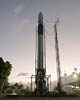 Kwajalein Atoll, Marshall Islands (SPX) Jan 11, 2006
The new launch time for Space X's maiden launch of its Falcon 1 rocket is February 8, at 4:30 p.m. California time, with Feb. 9 as a backup day. We will actually be ready to launch earlier, but are planning to spend extra time reviewing and double-checking all vehicle systems. |
|
|

| The content herein, unless otherwise known to be public domain, are Copyright 1995-2006 - SpaceDaily.AFP and UPI Wire Stories are copyright Agence France-Presse and United Press International. ESA PortalReports are copyright European Space Agency. All NASA sourced material is public domain. Additionalcopyrights may apply in whole or part to other bona fide parties. Advertising does not imply endorsement,agreement or approval of any opinions, statements or information provided by SpaceDaily on any Web page published or hosted by SpaceDaily. Privacy Statement |