|
 |
 |
 |
 |
 |
 |
 |
 |

 |
Light Shed On Long-Term Effects Of Logging After Wildfire
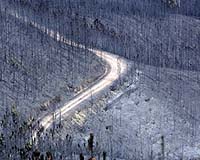
Portland OR (SPX) Apr 10, 2007 A new study on the effects of timber harvest following wildfire shows that the potential for a recently burned forest to reburn can be high with or without logging. Recently published in the journal, Forest Ecology and Management, the study demonstrates that the likelihood of a severe reburn is affected by the timing - not just the amount - of fuel accumulation after fire. The study examines fuel accumulation with and without logging after a large wildfire in the Blue Mountains of northeast Oregon. Three treatments were examined: commercial logging that removed only dead trees with value for wood products, commercial logging plus thinning that removed all dead trees larger than 4 inches in diameter, and unlogged sites. The year after logging (3 years after the fire), sites that were logged and thinned had four times more fine fuels on the ground, as a result of logging residue, compared to unlogged sites. Those same sites also had fewer snags- which provide habitat for woodpeckers, owls, and other animals that nest in tree cavities - and contribute to large woody debris on the ground. However, logging activity caused no change in the litter or duff, the upper soil organic layers that also affect how a fire burns. The study was led by James McIver of Oregon State University and Roger Ottmar of the Pacific Northwest Research Station, U.S. Forest Service. The investigators used a computer model to project how fuels and fire hazard would change over time. "Long-term research and monitoring are not always possible," says McIver. "Although we would rather have the long-term data, using a model allows us to estimate some of the future ecological effects." The computer simulation showed that the difference in surface fuels between logged and unlogged units would persist for about 15 years. The simulation also showed that if a fire did start during this time, it would likely kill most young trees as the fire carried through either logged or unlogged stands, even though the logged stands had higher slash fuels. This is because other components of the fuel bed (grasses and shrubs) would contribute significantly to fire conditions, whether sites were initially logged or not. "The exact nature of fuel accumulation over time is the key to understanding fire hazard," explains Ottmar. "Each forest, each fire, and each logging operation affects fuels differently, and variation exists within any forest stand. It is also important to consider the whole fuel bed when thinking about fire hazard in the future." Model projections indicated that large fuels will increase over time in the unlogged forests as dead trees fall over, with up to three times greater fuel accumulation as compared to a wildfire area that has been logged. Although it would seem that any extra fuel would be a cause for concern, these large fuels do not carry fire well on the surface, and so do not tend to create conditions for crown fires. Rather, they will tend to cause long periods of heating on the ground. "Wood can be fuel in the short term or the long term," says McIver, "but that's only part of the story. Wood is also wildlife habitat, and wood provides nutrients to the soil. Fire, ecological factors, and management objectives are all important. Our data show that there are no simple answers." Community Email This Article Comment On This Article Related Links Fuel mass and stand structure after post-fire logging Pacific Northwest Research Station Save the Forests at Wood Pile Forestry News - Global and Local News, Science and Application
 Trees To Offset The Carbon Footprint
 Livermore CA (SPX) Apr 10, 2007
How effective are new trees in offsetting the carbon footprint? A new study suggests that the location of the new trees is an important factor when considering such carbon offset projects. Planting and preserving forests in the tropics is more likely to slow down global warming. |
|
|

| The content herein, unless otherwise known to be public domain, are Copyright 1995-2006 - SpaceDaily.AFP and UPI Wire Stories are copyright Agence France-Presse and United Press International. ESA PortalReports are copyright European Space Agency. All NASA sourced material is public domain. Additionalcopyrights may apply in whole or part to other bona fide parties. Advertising does not imply endorsement,agreement or approval of any opinions, statements or information provided by SpaceDaily on any Web page published or hosted by SpaceDaily. Privacy Statement |