|
 |
 |
 |
 |
 |
 |
 |
 |

 |
Light Power Could Point And Stabilize Space Telescopes
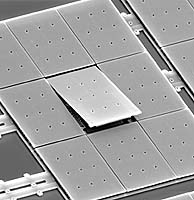
Tucson - Mar 18, 2002 Scientists at the University of Arizona in Tucson hope to harness sunshine to point and stabilize future space telescopes. Sunshine exerts a weak force on spacecraft. This has given space scientists headaches for years, gently turning spacecraft off target or off-orbit. But there has long been the idea of harnessing solar pressure with huge, gossamer solar sails to push spacecraft like high-tech clipper ships. "While most people think of solar sails for pushing with the pressure of light to accelerate and move spacecraft, our thought is to use that force to point the telescope and keep it in position," says Roger P. Angel, founder and director of the UA Mirror Lab. Currently, space telescopes are rotated, pointed and steadied by motors, gyroscopes and thrusters. As space telescopes become lighter and lighter, the vibrations and oscillations created by these devices can blur images. They also require using finite fuel supplies, whereas sunshine is an inexhaustible source of steering force as well as energy. Angel and UA researchers Blain Olbert and Paul Calvert want to take advantage of the solar shield that already is needed for space telescopes. This shield sits between the telescope and the sun to keep the cryogenically cooled telescope from heating up. The UA scientists visualize a shield shaped like a pyramid, with its sloping surfaces covered with hinged, reflecting tiles. Normally the tiles lie flat against the surfaces. When the tiles on one side of the pyramid are raised, however, the pressure balance is upset and the sunshade is pushed to one side. By raising tiles like ailerons on the right pyramid faces with electrical energy collected from solar cells, the solar pressure could be used to hold the spacecraft stable or to change its orientation or angular momentum. Key to all of this is developing suitable lightweight tiles that bend when a voltage is applied to them. UA engineers are exploring the feasibility of building these tiles under a $100,000 grant from NASA. Professor Paul Calvert and graduate student Blain Olbert, both of the Materials Science and Engineering Department, are working on the project. Olbert also is a staff engineer at UA's Steward Observatory. They are constructing tiles from piezoelectric polymer films that bend when a voltage is applied to them. "We are looking for polymer films that already are produced commercially and want to see if any of them are suitable for this application," Olbert says. The tiles will lie on the solar shield surface like shingles on a roof. One edge of each tile is glued to the shield. This glued edge acts as a hinge on which the tile rotates. Each glue joint and tile must survive hundreds of thousands of cycles during the spacecraft's 10-year life span without detaching or delaminating. "We are evaluating commercially available films and adhesives and the technologies for sticking them together," Olbert says. "Then there's the whole problem of lead technology. How do we attach the electrical leads to each tile that are needed to energize it? And we also have to think about redundancy because there are micro-meteorites out there that are constantly punching tiny holes through the tiles." In order to evaluate the films and adhesives, Olbert and others are building test tiles in a Steward Observatory laboratory. This is a difficult, tedious and time-consuming task because the films are like thin plastic wrap. Static charges make them stick to everything, and once they're creased, they're ruined. The adhesives also have to be carefully squeezed out from between the films as they're sandwiched together, which means low-viscosity adhesives are a must. Currently Olbert's work is funded under Phase I of NASA's Gossamer Spacecraft Initiative. NASA envisions gossamer spacecraft as large, ultra-light vehicles that can reconfigure themselves or evolve in response to changing mission conditions. Phase I is basically for evaluation of ideas. If NASA thinks the UA work shows promise, the project could be funded for Phase II, which calls for manufacturing and testing complete solar shield roof panels. "We are in the weeding-out phase right now," Olbert says. "There are lots of ideas that need to be turned into working solutions." Community Email This Article Comment On This Article Related Links UA Mirror Lab SpaceDaily Search SpaceDaily Subscribe To SpaceDaily Express Space Telescope News and Technology at Skynightly.com
 Carl Zeiss And Max Planck Researchers Develop Optical Technology For JWST
 Heidelberg, Germany (SPX) Dec 09, 2005
Carl Zeiss Optronics, in Oberkochen, Germany, and the Max Planck Institute for Astronomy in Heidelberg (MPIA), are developing the main fine mechanical optical technology for two instruments to be part of the James Webb Space Telescope (JWST).
--------------------------------------------------------- It's new. And it's downright terrific! Celestron's CPC Schmidt-Cassegrain telescope is the scope you've been waiting for! It offers new alignment technology, advanced engineering, and bold new design at a new, low price! In fact, Celestron's Professional Computerized (CPC) scope with revolutionary SkyAlign Alignment Technology redefines everything that amateur astronomers are looking for. It offers quick and simple alignment, GPS technology, unsurpassed optical quality, ease of use, advanced ergonomics, enhanced computerization and, most important, affordability. Want to view M-31 tonight? One button takes you there!
Shop for telescopes online at Telescopes.com! today!
|
|
|

| The content herein, unless otherwise known to be public domain, are Copyright 1995-2006 - SpaceDaily.AFP and UPI Wire Stories are copyright Agence France-Presse and United Press International. ESA PortalReports are copyright European Space Agency. All NASA sourced material is public domain. Additionalcopyrights may apply in whole or part to other bona fide parties. Advertising does not imply endorsement,agreement or approval of any opinions, statements or information provided by SpaceDaily on any Web page published or hosted by SpaceDaily. Privacy Statement |