|
 |
 |
 |
 |
 |
 |
 |
 |

 |
Light-Activated Glue Holds And Releases Workpieces In A Flash
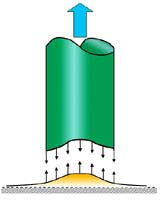
University Park PA (SPX) Aug 18, 2004 Penn State engineer has developed a new technology that uses light-activated glue to hold workpieces in position for machining, grinding and other manufacturing processes. Dr. Edward De Meter, professor of industrial and manufacturing engineering, who developed the concept, says, "This new technology offers an alternative to mechanical clamping, the approach industries most often use." "Capital investment for automated clamping is typically high and mechanical clamps can deform the workpiece, impede the manufacturing process and occupy processing space that could otherwise be used to hold additional workpieces." "Adhering workpieces to a fixture avoids these problems and can lead to significant improvements in manufacturing productivity, part quality and part cost." In the new approach, the workpiece is anchored to a steel fixture that conforms to the underside of the workpiece. At strategic locations on its surface, the fixture has holes capped with small, round, raised pads made of commercial sapphire, a relatively inexpensive ceramic material. These pads, which De Meter calls gripper pins, act as lenses or windows for ultra violet or infrared light used to set or destroy glue anchoring the workpiece. To load a workpiece, dabs of adhesive are placed on the gripper pins and the workpiece is put on top. A quick zap of low intensity ultraviolet light from a UV spot lamp delivered through the gripper pins causes the adhesive to set and form strong, tough, stiff bonds with the workpiece in seconds. The yield strength of the cured adhesive bond is greater than 5500 pounds per square inch. When machining or other processing is completed, infrared light delivered by a laser through the gripper pins destroys the adhesive bonds and releases the workpiece. The laser blast destroys the adhesive bonds in a fraction of a second without heat transfer to the fixture or the workpiece. De Meter says, "The adhesive that we use with our prototype is a commercially available product used for a variety of assembly operations in the electro-optics industry. "We add pigment to the adhesive so that it absorbs infrared light when hit with the laser," he explains. "The pigment enbrittles the adhesive and causes its yield strength to drop below 300 pounds per square inch. Usually the workpiece can be released from the fixture by hand or with a gentle tap from a rubber mallet." De Meter notes that vacuum chucks and magnetic clamps are currently available as alternatives to mechanical clamping. However, vacuum chucks can only handle light loads and magnetic clamps can only function with workpieces made from iron-containing materials. Light Activated Adhesive Gripper (LAAG), as De Meter calls the new workholding technology, enables a much wider variety of workpieces to be held, especially those originated as castings and forgings. The research on the new technology was supported, in part, by a Special Grant for Exploratory Research from the National Science Foundation. The University has a patent pending on the new technology and it will be showcased by Penn State and Masterworkholding, a company that has optioned the intellectual property, at the International Machine Tool Show (IMTS) in Chicago, Ill. from Sept. 8 to 15. Community Email This Article Comment On This Article Related Links Penn State SpaceDaily Search SpaceDaily Subscribe To SpaceDaily Express Space Technology News - Applications and Research
 NGC Chosen To Proceed With Developing Solid-State Laser Technology For Military Applications
 Redondo Beach CA (SPX) Jan 09, 2006
Northrop Grumman Corporation has been selected to develop "military-grade," solid-state laser technology that is expected to pave the way for the U.S. military to incorporate high-energy laser systems across all services, including ships, manned and unmanned aircraft, and ground vehicles. |
|
|

| The content herein, unless otherwise known to be public domain, are Copyright 1995-2006 - SpaceDaily.AFP and UPI Wire Stories are copyright Agence France-Presse and United Press International. ESA PortalReports are copyright European Space Agency. All NASA sourced material is public domain. Additionalcopyrights may apply in whole or part to other bona fide parties. Advertising does not imply endorsement,agreement or approval of any opinions, statements or information provided by SpaceDaily on any Web page published or hosted by SpaceDaily. Privacy Statement |