|
 |
 |
 |
 |
 |
 |
 |
 |

 |
Life Beneath The Ice In The Outer Solar System?
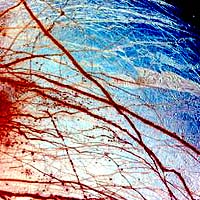
Milton Keynes - Apr 01, 2004 At present, we know of no worlds beyond our Earth where life exists. However, primitive organisms on our planet have evolved and adapted over billions of years, colonising the most inhospitable places. Since life seems to gain a foothold in the most hostile environments, it seems distinctly possible that living organisms could exist in ice- covered oceans on worlds far from the Sun, according to Dr. David Rothery (Open University), who will be speaking today at the RAS National Astronomy Meeting in Milton Keynes. Europa is the innermost of Jupiter's large icy satellites. It is slightly smaller than our own Moon, but its rocky interior is hidden beneath a 100 km blanket of ice. There has been much speculation as to whether the ice remains solid right down to the moon's rocky interior, or whether it consists of a thinner ice sheet floating on an ocean of water. Data from NASA's Galileo spacecraft, which orbited Jupiter from 1995 until 2003, provided detailed insights into Europa's structure that will not be surpassed until the arrival of NASA's Jupiter Icy Moons Orbiter (which may not be until 2023). The high-resolution Galileo images and other data revolutionised our knowledge of Europa's surface and interior structure, making it seem more likely that the ice is (at least at some times and in some places) relatively thin (much less than 10 km) and overlying a liquid water ocean. The images showed localized areas of 'melt-through' demonstrated by 'chaos' regions, where detached rafts of the icy shell can be seen dispersed in a now-refrozen matrix. The cause of melt-through is likely to be tidal heating, which is especially strong within Europa because it orbits within the immense gravity of Jupiter and experiences competing tidal pulls from the large, neighbouring moons, Io and Ganymede. This process also powers the widespread volcanic eruptions on Io. There may be occasional volcanic eruptions onto Europa's ocean floor - rather like a less active, ice-covered version of Io - or, more likely, hot springs where chemically-enriched water heated by passage through the rock re-emerges on the ocean floor. This sort of environment is currently regarded as the most likely place for life on Earth to have begun, and life on Europa could have arisen in just the same way. If so, life could survive there today, supported by chemical energy in the same way that the 'hydrothermal vents' on Earth's ocean floors support ecosystems that do not depend on sunlight. "Episodes of tidal heating in some of the Solar System's other icy bodies could equally well have given rise to life, even in such remote bodies as the newly discovered, remote planetoid Sedna if, as has been suggested, it has a satellite with which to interact tidally," said Dr. Rothery. "However, only in the case of Europa, and perhaps a few other satellites of the giant planets, does it seem plausible that life could flourish in the long term." Community Email This Article Comment On This Article Related Links Galileo at JPL RAS RAS National Astronomy Meeting SpaceDaily Search SpaceDaily Subscribe To SpaceDaily Express The million outer planets of a star called Sol
 Scientists Show Pluto To Be Colder Than It Should Be
 Cambridge MA (SPX) Jan 5, 2006
Mercury is boiling. Mars is freezing. The Earth is just right. When it comes to the temperatures of the planets, it makes sense that they should get colder the farther away they are from the Sun. But then there is Pluto. It has been suspected that this remote world might be even colder than it should be. Smithsonian scientists now have shown this to be true. |
|
|

| The content herein, unless otherwise known to be public domain, are Copyright 1995-2006 - SpaceDaily.AFP and UPI Wire Stories are copyright Agence France-Presse and United Press International. ESA PortalReports are copyright European Space Agency. All NASA sourced material is public domain. Additionalcopyrights may apply in whole or part to other bona fide parties. Advertising does not imply endorsement,agreement or approval of any opinions, statements or information provided by SpaceDaily on any Web page published or hosted by SpaceDaily. Privacy Statement |