|
 |
 |
 |
 |
 |
 |
 |
 |

 |
Lessons Learnt From Drought Deaths 40,000 Years Ago
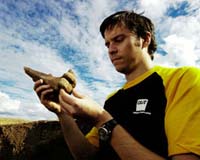
Brisbane, Australia (SPX) Nov 28, 2006 Drought-stricken Australia should heed a warning from a new study that shows a series of massive droughts killed giant kangaroos and other "megafauna" in south-east Queensland 40,000 years ago, according to researchers from the Queensland University of Technology. Scientists Dr Gilbert Price and Dr Gregory Webb believe understanding how the prehistoric big dry caused extinctions could help predict how and if animals battling current climate change will survive. The QUT research into the giant Australian marsupials and reptiles and the impact of climate change will be published in the December issue of the Australian Journal of Earth Sciences. Dr Price and Dr Webb studied the fossil-rich Darling Downs area of south-east Queensland with the help of palaeontologists from the Queensland Museum and an amateur local fossil hunter, Ian Sobbe. Dr Price said what the team unearthed showed that giant kangaroos and other large wildlife that roamed the area in the late Pleistocene age were drought-stressed when they died. "What makes this research so relevant to climate change theories today is that the profile of the fossil kangaroo populations is identical to that of a modern drought-stressed kangaroo mob," he said. "It provides, for the first time, evidence which suggests that the megafauna kangaroos were greatly affected by a series of catastrophic droughts. "These animals of the prehistoric Australian bush were the largest of their time and included gigantic wombats the size of cars, kangaroos that reached almost 2.5 metres tall, and massive emus and goannas. "There's nothing we can do now to save these animals - they're all extinct. "But if we can understand how those animals responded to the massive droughts and climate change events of the past, we might be able to go some way in predicting the effects of future climate changes and its impact on the way that we manage and conserve the precious habitats and wildlife of the Australian bush." Dr Price said the layers of fossils in the dig area at the Darling Downs were not consistent with some theories that humans had wiped out megafauna. "Some scientists believe in the 'blitzkrieg' megafauna extinction hypothesis which blames humans for over-hunting these giant marsupials," he said. "If that was the case, these fossils dating back thousands of years would show the animals dying out at the same point in time. But they don't. These layers of fossils buried at a single site under the Darling Downs show a progressive, three-stage extinction over time that relates to periods of climate change." Dr Webb said the research had unearthed indicators that the Darling Downs had been a semi-arid environment 40,000 years ago, rather than sub-tropical or tropical. "Sedimentological information shows that the Darling Downs was experiencing repeating cycles of wet and dry conditions, resulting in droughts and periodic flash flooding from storms, during the time when the megafauna populations were declining," he said. "The research found no evidence of humans being involved in the accumulation of fossils in the catchment at the time of deposition, but is perfectly consistent with their decline being caused by increasing aridity. "So it's most likely that Australia's giant kangaroos and other megafauna in this area were driven to extinction by the hands of Mother Nature." Dr Price, who received his PhD this year for his research, and Dr Webb are both researchers with QUT's School of Natural Resource Sciences and QUT's Institute of Sustainable Resources. Community Email This Article Comment On This Article Related Links Queensland University of Technology Weather News at TerraDaily.com Climate Science News - Modeling, Mitigation Adaptation
 Kyoto Countries Set 2008 For Talks On Further Carbon Cuts
 Nairobi (AFP) Nov 17, 2006
The 168 members of the United Nations' pact for cutting greenhouse gases will launch negotiations in 2008 over the next round of pledges for tackling global warming, a worldwide conference on climate change decided here on Friday. The negotiations will determine action for curbing carbon pollution from 2013 to 2017, after Kyoto's present commitment period expires in 2012. |
|
|

| The content herein, unless otherwise known to be public domain, are Copyright 1995-2006 - SpaceDaily.AFP and UPI Wire Stories are copyright Agence France-Presse and United Press International. ESA PortalReports are copyright European Space Agency. All NASA sourced material is public domain. Additionalcopyrights may apply in whole or part to other bona fide parties. Advertising does not imply endorsement,agreement or approval of any opinions, statements or information provided by SpaceDaily on any Web page published or hosted by SpaceDaily. Privacy Statement |