|
 |
 |
 |
 |
 |
 |
 |
 |

 |
Learning To Deep Drill On Earth
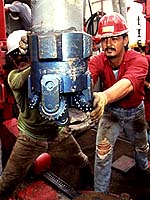
Morgantown - Aug 26, 2002 "Deeper" and "smarter" will likely be the watchwords of America's natural gas industry in the coming years. Already, more than 70 percent of gas produced in the continental United States comes from wells deeper than 5,000 feet. But in the not-too-distant future, as America's demand for clean-burning natural gas increases, drillers will likely be required to probe much deeper � perhaps 15,000 feet or more beneath the earth's surface where an estimated 125 trillion cubic feet of unclaimed natural gas is thought to be trapped. To help develop the high-tech drilling tools the industry will need to tackle these deeper deposits, the U.S. Department of Energy Office of Fossil Energy is kicking off "Project Deep Trek." The goal is to develop a "smart" drilling system tough enough to withstand the extreme conditions of deep reservoirs, yet economical enough to make the gas affordable to produce. The target date for developing the advanced drilling system is 2010. The Energy Department's National Energy Technology Laboratory, the research arm of the department's fossil energy program, has begun asking industry to propose "Deep Trek" development efforts. The agency is initially funding the initiative at $10.4 million. Proposers will have two opportunities this year to respond. The first will be by April 11, when the department is asking prospective proposers to submit a "pre-application" � a mini-proposal no longer than seven pages. After the pre-applications are reviewed, applicants will be advised as to whether they should submit a more detailed, comprehensive application due May 30. The second opportunity will come by November 30, when another set of "pre-applications" will be due, and comprehensive applications will be requested by January 13, 2003. The department will fund three phases of Deep Trek research and development: feasibility and concept definition (Phase I), prototype development or research, development and testing (Phase II), and field/system demonstration and commercialization (Phase III). Technologies need not go through all three levels of development if they already have completed several years of research. For instance, technologies that are proved to be feasible may be eligible for phases II and III. Others that are more mature may bypass phases I and II and qualify for a field demonstration. No phase is planned to last longer than four years. Private partners must contribute a minimum of 20 percent for Phase I projects, 35 percent for Phase II, and 50 percent for Phase III. The National Energy Technology Laboratory will coordinate work with private industry, other national laboratories and universities. The importance of deeper drilling technologies was underscored in the 1999 report of the National Petroleum Council, entitled "Natural Gas: Meeting the Challenges of the Nation's Growing Natural Gas Demand." In the report, the Council stated, "Deep drilling is increasing....Production from depths deeper than 10,000 feet is expected to increase from 35 percent in 2000 to 41 percent by 2010. It is important to note, however, that industry's ability to achieve production from deeper horizons will be dependent on adequate deep drilling infrastructure and the continued evolution of technology." The Council predicted that by 2010, 12 percent of all U.S. gas produced will have to come from deep formations � those 15,000 feet and deeper. During this same time frame, production from gas wells less than 10,000 feet deep is expected to decline, as these reservoirs begin to deplete. According to a study performed by the Energy Department and the U.S. Geological Survey last year, significant gas resources in the United States lie 15,000 feet and deeper below the earth=s surface. DOE estimates these gas resources at about 125 trillion cubic feet � equivalent to about five years of total U.S. gas consumption. Tapping into this resource, however, will be daunting and expensive. In fact, in the few deep wells being drilled today, as much as 50 percent of the drilling costs is spent on drilling the last 10 to 25 percent of the wells where rock formations are harder and temperatures are higher. Today's sensors, drill bits and materials are ineffective when exposed to harsh, extreme conditions found in deep formations. To help remedy this situation, technologies pursued in the Deep Trek project include low-friction, wear-resistant materials and coatings, advanced sensors and monitoring systems, advanced drilling and completion systems, and new bit technology that could be integrated into a high-performance, "smart" system. The new system is to operate in extreme temperatures (more than 347o F) and pressures (greater than 10,000 pounds per square inch). The real advantage of a "smart" system is its ability to report key measurements � temperature, pressure, moisture, geology, etc. � as a well is drilled, pinpointing potential trouble spots on a "real-time" basis. This allows operators to make adjustments as drilling continues, avoiding costly work stoppages. Community Email This Article Comment On This Article Related Links Department of Energy Office of Fossil Energy SpaceDaily Search SpaceDaily Subscribe To SpaceDaily Express Space Technology News - Applications and Research
 Industry Team Achieve New Communications Technology With AESA Radars
 Baltimore MD (SPX) Jan 12, 2006
A team comprised of three leading US aerospace and defense contractors has demonstrated an innovative technological use of active electronically scanned array (AESA) radars for high-bandwidth communications. |
|
|

| The content herein, unless otherwise known to be public domain, are Copyright 1995-2006 - SpaceDaily.AFP and UPI Wire Stories are copyright Agence France-Presse and United Press International. ESA PortalReports are copyright European Space Agency. All NASA sourced material is public domain. Additionalcopyrights may apply in whole or part to other bona fide parties. Advertising does not imply endorsement,agreement or approval of any opinions, statements or information provided by SpaceDaily on any Web page published or hosted by SpaceDaily. Privacy Statement |