|
 |
 |
 |
 |
 |
 |
 |
 |

 |
Lasers Key To Construction, Manufacturing, Defense Advances
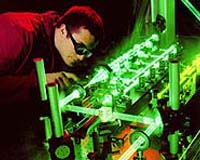
Gaithersburg MD (SPX) Jul 05, 2004 Lasers, already used for everything from price scanning at the supermarket to eye surgery, now are likely to dramatically change the construction, large-scale manufacturing, remote sensing and defense industries. A new National Institute of Standards and Technology (NIST) report predicts "tremendous" applications for laser scanning devices, also known as LADARs (for Laser Detection and Ranging) and argues for a vigorous effort to create next-generation LADAR - a coffee-cup-size device with millimeter accuracy. The results, says study director William C. Stone, "could be comparable to the advances achieved when computers were first matched with machinery." Industry has used LADAR systems, which create three-dimensional images of areas and objects, since the late 1970s. Recent advances in microchip lasers, optics, microelectromechanical systems (MEMS) and computers, however, have increased LADAR's speed of data acquisition, range accuracy and reliability, as well as reduced its size and costs. LADARs now are used to generate topographic images, to survey the depths of large bodies of water, and as three-dimensional documentation of construction when building plans are not available. Manufacturers also are beginning to use LADARs as a tool to recreate critical machine components from single examples. NIST is testing LADAR as a tool for remote management of construction sites and for navigating unoccupied military vehicles. (The latter research could soon lead to collision-avoidance advances for civilian automobiles.) To spur greater LADAR industrial use, NIST also is working to develop test objects for LADAR performance standards so industry can have confidence in laser scanning readings and comparison of systems. Other LADAR research currently under way at NIST includes work on rapid, long-range automated identification systems for remote scanning and inventory of construction materials; automated LADAR-based docking systems for building construction cranes; and basic scientific and engineering research that will enable development of miniature, high-resolution, low-cost, next-generation LADAR systems. Community Email This Article Comment On This Article Related Links Building and Fire Laboratory at NIST SpaceDaily Search SpaceDaily Subscribe To SpaceDaily Express Space Technology News - Applications and Research
 LIGO Up And Running, But Gravity Waves Remain Elusive
 Washington DC (SPX) Jan 10, 2006
Scientists working on the Laser Interferometer Gravitational-Wave Observatory said Monday the facility has reached its target detection sensitivity, but the goal of finding the elusive phenomena known as gravity waves remains as elusive as ever. |
|
|

| The content herein, unless otherwise known to be public domain, are Copyright 1995-2006 - SpaceDaily.AFP and UPI Wire Stories are copyright Agence France-Presse and United Press International. ESA PortalReports are copyright European Space Agency. All NASA sourced material is public domain. Additionalcopyrights may apply in whole or part to other bona fide parties. Advertising does not imply endorsement,agreement or approval of any opinions, statements or information provided by SpaceDaily on any Web page published or hosted by SpaceDaily. Privacy Statement |