|
 |
 |
 |
 |
 |
 |
 |
 |

 |
Laser Method Identifies, Counts Toxic Molecules
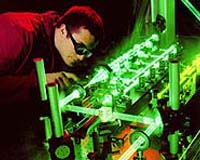
Washington - Feb 16, 2004 A spectroscopy technique that offers advances in detection of toxic chemicals and counting of molecules has been demonstrated by a National Institute of Standards and Technology (NIST) scientist and collaborators. Described in the Feb. 8 issue of the Journal of Chemical Physics, the NIST-patented technique may be useful for development of miniaturized chemical sensors, as well as for fundamental surface science studies. The technique (a variation on cavity ring-down spectroscopy) relies on laser light reflecting and circulating inside a prism-like optical resonator. The time it takes the light to diminish (or ring down) changes depending on whether specific chemicals are present near the resonator and on how much light they absorb. This information can be used to identify and quantify specific molecules. The technique can detect small amounts (100 parts per million) of trichloroethylene, a toxic commercial solvent that is prevalent but difficult to locate in the environment. The sensitivity is equivalent to the best of other published optical methods that could be used outside a laboratory. A highly selective coating is expected to enhance performance further. The technique also was used to determine the number of molecules per unit area on a surface ("absolute coverage") without the need for ultrahigh vacuum experimental conditions, which are typically required for such measurements. Hence, the new approach enables quantitative studies of real-world surface processes, such as catalytic reactions. Absolute coverage measurements are useful in surface science, providing key information about surface reactions or structures for many applications, such as improving solar cell efficiency. Community Email This Article Comment On This Article Related Links National Institute of Standards and Technology SpaceDaily Search SpaceDaily Subscribe To SpaceDaily Express Space Technology News - Applications and Research
 LIGO Up And Running, But Gravity Waves Remain Elusive
 Washington DC (SPX) Jan 10, 2006
Scientists working on the Laser Interferometer Gravitational-Wave Observatory said Monday the facility has reached its target detection sensitivity, but the goal of finding the elusive phenomena known as gravity waves remains as elusive as ever. |
|
|

| The content herein, unless otherwise known to be public domain, are Copyright 1995-2006 - SpaceDaily.AFP and UPI Wire Stories are copyright Agence France-Presse and United Press International. ESA PortalReports are copyright European Space Agency. All NASA sourced material is public domain. Additionalcopyrights may apply in whole or part to other bona fide parties. Advertising does not imply endorsement,agreement or approval of any opinions, statements or information provided by SpaceDaily on any Web page published or hosted by SpaceDaily. Privacy Statement |