|
 |
 |
 |
 |
 |
 |
 |
 |

 |
Largest Arctic Ice Shelf Breaks Up, Draining Freshwater Lake
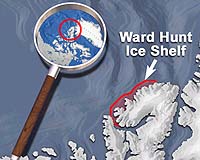
Quebec City - Sep 24, 2003 The largest ice shelf in the Arctic has broken, and scientists who have studied it closely say it is evidence of ongoing and accelerated climate change in the north polar region. The Ward Hunt Ice Shelf is located on the north coast of Ellesmere Island in Canada's Nunavut territory and its northernmost national park. This ancient feature of thick ice floating on the sea began forming some 4,500 years ago and has been in place for at least 3,000 years. Warwick Vincent and Derek Mueller of Laval University in Quebec City, Quebec, and Martin Jeffries of the University of Alaska Fairbanks have studied the Ward Hunt Ice Shelf on site and through RADARSAT imagery and helicopter overflights. They report in the journal Geophysical Research Letters that a three decade long decline in the Ward Hunt Ice Shelf culminated in its sudden break-up between 2000 and 2002. It fragmented into two main parts with many additional fissures. It also calved a number of ice islands, some of which are large enough to pose a danger to shipping and to drilling platforms in the Beaufort Sea. An immediate consequence of the ice shelf's rupture was the loss of almost all of the freshwater from the northern hemisphere's largest epishelf lake, which had been dammed behind it in 30 kilometer [20 mile] long Disraeli Fiord. An epishelf lake is a body of mostly freshwater trapped behind an ice shelf. The freshwater layer in the Disraeli Fiord measured 43 meters [140 feet] in depth and lay atop 360 meters [1,200 feet] of denser ocean water. The loss of fresh and brackish water has affected a previously reported unique biological community, consisting of both freshwater and marine species of plankton. The breakup of the ice shelf has also reduced the habitat available for cold-tolerant communities of microscopic animals and algae that live on the upper ice surface. A century ago, the entire northern coast of Ellesmere Island, the northernmost land mass of North America, was fringed with a continuous ice shelf, as explorer Robert E. Peary reported in 1907. About 90 percent of the ice area had been lost, through calving from its northern edge, by 1982, the authors say. Since then, the remnant ice shelves, including Ward Hunt, had remained relatively stable until April 2000, when RADARSAT's synthetic aperture radar revealed the first sign of cracking. Subsequent imagery showed the crack extending in length, and in 2002, observations from a helicopter showed that the fracture now extended fully from the fiord to the open ocean, breaking the ice shelf into two major parts and many smaller ones. In July and August 2002, Vincent's team landed on the Ward Hunt Ice Shelf to make direct measurements of its break-up. They found cracks that separated the central part of the shelf into free floating ice blocks. These were held in place by parts of the ice shelf that remained intact. Then, in August 2002, the northern edge of the ice shelf calved, resulting in the loss of six square kilometers [two square miles] of ice islands and 20 square kilometers [eight square miles] of thick multi-year sea ice attached to the ice shelf. The remaining ice shelf may only be about half the thickness previously reported, the researchers say. The scientists note that in the West Antarctic, atmospheric warming has been cited as the cause for ice shelf collapses. There, temperatures have risen by about one-half of a degree Celsius [one degree Fahrenheit] per decade over the past 60 years. On northern Ellesmere Island, the longest temperature records have been maintained at Alert, 175 kilometers [109 miles] to the east of Disraeli Fiord. At Alert, a temperature increase of just one-tenth of a degree Celsius [one-fifth of a degree Fahrenheit] per decade has been observed since 1951. But during the period 1967 to the present, the temperature increase has been about four times that rate, about equal to that of Antarctica. The actual temperature on the ice shelf was measured in 2001 and 2002 and correlated with the Alert data, in order to project backwards the ice shelf temperature. This yielded an average July surface temperature of 1.3 degrees Celsius [34 degrees Fahrenheit] for the years 1967-2002, which is well above the zero degrees Celsius [32 degrees Fahrenheit] that is considered the critical threshold for ice shelf breakup in Antarctica, according to the researchers. Mueller, Vincent, and Jeffries attribute the disintegration of the Ellesmere Ice Shelf and the breakup of the Ward Hunt Ice Shelf to the cumulative effects of long-term warming since the 19th century. The precise timing and pattern of fracturing of the climate-weakened ice shelf may have been influenced by freeze-thaw cycles, wind, and tides, they say. Other factors may include changes in Arctic Ocean temperature, salinity, and flow patterns, they add. Community Email This Article Comment On This Article Related Links American Geophysical Union SpaceDaily Search SpaceDaily Subscribe To SpaceDaily Express Dirt, rocks and all the stuff we stand on firmly
 Magnetic Reconnection Region Larger Than 2.5 Million Km Found In The Solar Wind
 Paris (ESA) Jan 12, 2006
Using the ESA Cluster spacecraft and the NASA Wind and ACE satellites, a team of American and European scientists have discovered the largest jets of particles created between the Earth and the Sun by magnetic reconnection. This result makes the cover of this week's issue of Nature. |
|
|

| The content herein, unless otherwise known to be public domain, are Copyright 1995-2006 - SpaceDaily.AFP and UPI Wire Stories are copyright Agence France-Presse and United Press International. ESA PortalReports are copyright European Space Agency. All NASA sourced material is public domain. Additionalcopyrights may apply in whole or part to other bona fide parties. Advertising does not imply endorsement,agreement or approval of any opinions, statements or information provided by SpaceDaily on any Web page published or hosted by SpaceDaily. Privacy Statement |