|
 |
 |
 |
 |
 |
 |
 |
 |

 |
Large Survey Of Galaxies Yields New Findings On Star Formation
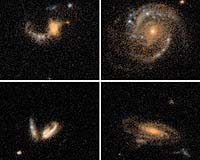
Santa Cruz CA (SPX) Jan 10, 2006 New findings from a large survey of galaxies suggest that star formation is largely driven by the supply of raw materials, rather than by galactic mergers that trigger sudden bursts of star formation. Stars form when clouds of gas and dust collapse under the force of gravity, and the study supports a scenario in which exhaustion of a galaxy's gas supply leads to a gradual decline in the star-formation rate. The results, presented this week at the American Astronomical Society (AAS) meeting in Washington, D.C., come from the Extended Groth Strip Survey, a collaborative effort using major ground-based and space-based telescopes to focus on one patch of sky that offers a clear view of the distant universe. By analyzing data from a combination of powerful instruments, researchers derived information on galaxy weights and star formation rates, as well as the numbers of stars already formed, for more than 3,500 galaxies. They found that the weight (or mass) of a galaxy is an important factor determining how fast it makes stars and how the star formation rate evolves over time, said Kai Noeske, a postdoctoral researcher at the University of California, Santa Cruz. "The picture we're getting is that heavy galaxies form stars early and rapidly, whereas smaller galaxies form their stars over longer timescales," said Noeske, who presented the group's findings at the AAS meeting on Monday, January 9. The study's findings shed light on ongoing debates over the physical mechanisms that activate star formation in galaxies--in particular, the importance of starbursts triggered by mergers of similar galaxies. "What we see is consistent with mostly undisturbed galaxies using up their gas over time, like firewood burning down," Noeske said. The Extended Groth Strip collaboration consists of astronomers from 16 institutions who have pooled their data and resources to create what is now one of the most intensely studied regions of the sky, said David Koo, professor of astronomy and astrophysics at UCSC and a member of the team. Light from distant galaxies takes billions of years to reach Earth, giving astronomers a window into the past. The galaxies included in this study cover a wide range of redshifts (a measure of distance) and corresponding "lookback times," extending out to redshift 1.4 or as far back in time as 9 billion years, about two-thirds of the age of the universe. The study also encompassed galaxies with a wide range of masses. "We have now been able to track star formation in galaxies out to modest distances, more than half the age of the universe, and we find that all galaxies, big or small, seem to be fading gradually so that they are less active today than they were further back in time," Koo said. Astronomers have found from previous galaxy surveys that star formation activity becomes more intense as they probe farther back in time. One proposed explanation has been that galaxy mergers were more frequent in the past, triggering bursts of star formation due to compression of gas clouds during the merger process. "We are finding that mergers do not appear to play the dominant role in star formation, because we see normal-looking, undisturbed galaxies that are undergoing large amounts of star formation," Koo said. "There probably are multiple mechanisms that can activate star formation. We are asking which is dominant," he added. "Mergers do drive star formation; they just don't seem to be the major driver." Koo and Noeske are both members of the DEEP2 team, one of seven survey teams involved in the Extended Groth Strip Survey. DEEP (Deep Extragalactic Evolutionary Probe) began about 15 years ago, led by Koo and other UCSC astronomers using the twin 10-meter Keck Telescopes at the W. M. Keck Observatory in Hawaii and NASA's Hubble Space Telescope to conduct a large-scale survey of distant field galaxies. Phase 2 of the project, led by UCSC and UC Berkeley, began three years ago using the powerful DEIMOS spectrograph on the Keck II Telescope and has now gathered spectroscopic data from almost 40,000 distant galaxies. DEEP2 has observed 13,000 galaxies in the Extended Groth Strip, one of four fields surveyed by the project. Joining the DEEP2 team in the Extended Groth Strip Survey is a broad consortium of other survey teams that are contributing data. Infrared data from NASA's Spitzer Space Telescope were especially important for Noeske's study, because they enable astronomers to see through the dust that obscures much of the star formation taking place in distant galaxies. "Having the infrared data from Spitzer allows us to measure the star formation rates very accurately because we are no longer blinded by dust," Koo said. The array of instruments trained on the Extended Groth Strip covers a tremendous range of wavelengths, including x-rays and radio waves, as well as infrared, visible, and ultraviolet light. "This is an exceptional period of time for astronomy, because for the first time we are able to combine data from almost all of the important wavelengths," Koo said. This work is linked to other projects that analyze Extended Groth Strip data. The same session at the AAS meeting includes a presentation by Kevin Bundy of the California Institute of Technology on how the termination of star formation is related to a galaxy's weight and environment. Projects led by Jennifer Lotz of the National Optical Astronomy Observatory (NOAO) and Lihwai Lin of National Taiwan University measure the frequency of galaxy mergers and their importance in the production of new stars over the past 8 billion years. The following teams contributed to the study presented by Noeske at AAS: DEEP2 team: Marc Davis (principal investigator), Jeffrey Newman, and Michael Cooper at UC Berkeley; Sandra Faber (co-PI), Kai Noeske (lead author), David Koo, and Susan Kassin at UCSC; Benjamin Weiner at the University of Maryland; Christopher Willmer and Alison Coil at the University of Arizona; and Jennifer Lotz at NOAO. Spitzer IRAC team (Infrared Array Camera on the Spitzer Space Telescope): Giovanni Fazio (PI), Jiasheng Huang, and Pauline Barmby at the Harvard-Smithsonian Center for Astrophysics, and Gillian Wilson at the Spitzer Science Center, Caltech. Spitzer MIPS team (Multiband Imaging Photometer for Spitzer): George Rieke (PI), Emeric Le Floc'h, and Casey Papovich at the University of Arizona. Palomar Near Infrared Survey: Richard Ellis (PI) and Kevin Bundy at Caltech, and Christopher Conselice (co-PI) at the University of Nottingham, UK. GALEX team (Galaxy Evolution Explorer satellite): Christopher Martin (PI) and Todd Small at Caltech, and David Schiminovich at Columbia University. The EGS collaboration also includes radio astronomers observing this region with the NRAO Very Large Array and the James Clerk Maxwell Telescope. Institutions involved in the collaboration include, in addition to those listed above, Imperial College of London, Space Telescope Science Institute, Herzberg Institute of Astrophysics in Canada, National Taiwan University, UCLA, Oxford University, and the Royal Observatory of Edinburgh. Community Email This Article Comment On This Article Related Links University of California - Santa Cruz AAS SpaceDaily Search SpaceDaily Subscribe To SpaceDaily Express Stellar Chemistry, The Universe And All Within It
 Sloan Survey Identifies New Dwarf Galaxy Inside Milky Way
 Washington DC (SPX) Jan 10, 2006
Astronomers using the Sloan Digital Sky Survey have discovered a previously unknown cluster of stars within the Milky Way that appears to be a separate dwarf galaxy being consumed by its much larger neighbor. |
|
|

| The content herein, unless otherwise known to be public domain, are Copyright 1995-2006 - SpaceDaily.AFP and UPI Wire Stories are copyright Agence France-Presse and United Press International. ESA PortalReports are copyright European Space Agency. All NASA sourced material is public domain. Additionalcopyrights may apply in whole or part to other bona fide parties. Advertising does not imply endorsement,agreement or approval of any opinions, statements or information provided by SpaceDaily on any Web page published or hosted by SpaceDaily. Privacy Statement |