|
 |
 |
 |
 |
 |
 |
 |
 |

 |
LM Completes Internal Preliminary Design Review On APKWS II Candidate
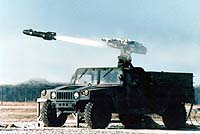
Orlando FL (SPX) Apr 07, 2006 Lockheed Martin's Advanced Precision Kill Weapon System II (APKWS II) team successfully completed an internal Preliminary Design Review (PDR) March 28-30. The PDR, held in Orlando, was attended by Lockheed Martin and supplier program subject matter experts, as well as outside technical consultants. The independent review team, which included participation from outside agencies, stated: "This team has done an excellent job of capturing all of the issues that are important to making this weapon work." Successful completion of this PDR positions the Lockheed Martin APKWS II candidate for a Critical Design Review at month 3 of the contracted effort, if Lockheed Martin is chosen as the prime contractor for the U.S. Army APKWS II program. "Completing an all-up PDR prior to contract award demonstrates the maturity of our design," said Steve Barnoske, director - Tactical Missiles at Lockheed Martin Missiles and Fire Control. "We have made a substantial investment in risk reduction, and this comprehensive review showed it is paying off with a high-confidence, low-risk and very affordable design." "The PDR represents a major accomplishment and establishes the basis for an on-schedule, on-cost program execution," Barnoske continued. "It summarizes nine months of a contractor-funded pre-award development program that took us through subassembly designs and test, to a successful guided flight. And, if we are selected to provide APKWS II, it puts us right where we need to be to get this much-needed new capability to the field as soon as possible." The rigorous review covered all aspects of the Lockheed Martin APKWS II design. During the three-day event, engineering task leaders made presentations summarizing the program's design and successful testing, both at the system and sub-system levels. Major focus during the PDR was placed on the nose-mounted semi-active laser seeker, which Lockheed Martin believes can outperform a canard-mounted design; and on the rocket firing adapter, which enables the use of an existing, unmodified off-the-shelf Hydra 70 rocket, as specified in the Army's Request for Proposal. "Our successful guided test flight validated our low-risk design approach of taking a Hydra 70 rocket off the shelf, adding on a new guidance section, isolating and controlling roll, maintaining stable aerodynamics and delivering the pinpoint accuracy APKWS II requires," Barnoske said. "To minimize risk and ensure rapid fielding, it is very important not to make unqualified changes to the already proven and fielded motor--to give the customer exactly what the customer has asked for. Our design does that, and it works." "Our familiarity with all the required APKWS II platforms, including the fire control systems, the launchers and the integration of the HELLFIRE missile, reduces platform integration risk," Barnoske added. "And our ready production lines mean we can deliver an affordable product--with Lockheed Martin's historical cost credibility." The APKWS II is a 2.75-inch laser-guided rocket that will provide crews of the U.S. Army Apache and Marine Corps Cobra attack helicopters and other platforms with precision-strike capability against non-armored targets that do not require a 7-inch HELLFIRE(R) missile--an option not presently available. This low-cost alternative will destroy low-value but dangerous targets that are close to civilian assets and/or friendly forces. Lockheed Martin's industry team for APKWS II includes HR Textron, a wholly owned subsidiary of Textron, Inc. (NYSE: TXT), Santa Clarita, CA, which will supply the control actuation system; Honeywell D&S (NYSE: HON), Minneapolis, MN, the inertial sensor assembly (ISA); EaglePicher, Joplin, MO, the thermal battery; and ITT Power Solutions (NYSE: ITT), West Springfield, MA, (formerly K and M Electronics), the power supply. Lockheed Martin plans to produce the APKWS II seeker at its plant in Ocala, FL, with final rocket assembly at its facility in Troy, AL. The control actuation system will be produced at HR Textron's plant in Santa Clarita, CA; the inertial sensor assembly, at Honeywell's facility in Minneapolis, MN. Community Email This Article Comment On This Article Related Links Lockheed Martin The latest in Military Technology for the 21st century at SpaceWar.com
 Lockheed Martin Receives Contract For F-2 Component Work
 Fort Worth TX (SPX) Apr 12, 2006
Lockheed Martin received a contract from Mitsubishi Heavy Industries (MHI) on March 31 valued at over $145 million to manufacture components for five additional F-2 production aircraft. MHI is the prime contractor for the F-2, Japan's operational support fighter. |
|
|

| The content herein, unless otherwise known to be public domain, are Copyright 1995-2006 - SpaceDaily.AFP and UPI Wire Stories are copyright Agence France-Presse and United Press International. ESA PortalReports are copyright European Space Agency. All NASA sourced material is public domain. Additionalcopyrights may apply in whole or part to other bona fide parties. Advertising does not imply endorsement,agreement or approval of any opinions, statements or information provided by SpaceDaily on any Web page published or hosted by SpaceDaily. Privacy Statement |