
 |
 |
 |
 |
 |
 |
 |
 |
 |

 |
Kosovo Civilian Carnage Demands Better Target Identification
Washington - October 15, 1999 - 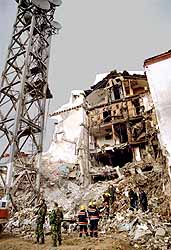 Washington - October 15, 1999 - Enemy forces will have a harder time hiding from U.S. air power in the future as new research projects prove effective in identifying hidden, moving targets.
Despite the sophistication of U.S. surveillance and intelligence systems, three classes of targets are still troublesome for U.S. air forces. These include moving targets, mobile surface-to-air missile radar sites, and camouflaged targets. Without putting a human eye on these targets, they often remain elusive and cannot be destroyed. Caption: Yugoslav soldiers and Belgrade rescue workers search through the rubble at the Serbian television building trying to find more survivors in the basement. The building was intentionally targeted for NATO air strikes on April 23 resulting in the death of over 10 journalists and technichans. Photo Copyright AFP The Defense Advanced Research Agency has launched a technical assault to lift the fog of war surrounding these targets and replace it with a clear picture of what and where enemy forces are located at any given moment in time. Specifically, the agency's research efforts are focused on:
In the case of moving and mobile targets, the goal is to capitalize on current technology and then network the available data coming in from air and space vehicles, much like information from various programs on a personal computer can be networked to create a document. "The whole idea is if we can network existing sensors we can get a far more precise location for targets while they're moving than from an individual sensor," Carlini said. "And just by virtue of doing that you can direct existing weapons in flight and tell them where to go as the targets are moving." Carlini said an example of what he refers to as sensors include such systems as JSTARS, the Joint Surveillance Target Attack Radar System. The problem, he said, is systems aimed at gauging ground moving targets are mainly used for intelligence and surveillance, not targeting. "The systems look for clumps of targets but don't do very precise measurements on individual targets," Carlini said. "What also doesn't exist is the ability to network information from individual sensors to get more precise locations." For example, Carlini said if the ability existed to instantaneously network data from a JSTARS aircraft, and an unmanned aerial vehicle and spaced-based satellites, it would be easier to identify targets and track them. He said a similar approach is being used to solve the problem of identifying and locating mobile surface-to-air missile radar sites. In that case, Carlini said, the goal is to put sensor systems on available platforms in the theater of operations and share the data produced by emissions from the radar sites. "By doing so, we believe we can very accurately determine where the emissions are coming from. The goal is the same as with moving targets. We're working the targeting side to try to get a very accurate location and then use existing weapons to engage." Identifying camouflaged and hidden targets, according to Carlini, is a more difficult problem. Current radar images don't penetrate trees. "To penetrate the tree you have to go to a much lower frequency radar signal, which in turn does not create a high quality image. So what we're doing is developing what's called foliage penetration synthetic aperture radar." Carlini explained that synthetic aperture radar creates images more like what the human eye is used to seeing. "It doesn't look exactly like a photograph, but if you get sufficient resolution it's close. The challenge for foliage penetration synthetic aperture radar is to automatically process and interpret low resolution imagery." While use of such techniques to locate moving, mobile and hidden targets on the battlefield is likely years away, DARPA is already moving ahead with testing. A foliage penetration system will be tested in 2000, as will technology for identifying and precisely tracking moving targets. Technology for identifying and precisely targeting mobile surface-to-air missile radar sites is currently slated for testing in 2002. Carlini said the benefits of such research offer "a quantum leap in capabilities." "Just knowing where camouflaged and hidden targets exist is a big step forward. And in the case of emitting targets, that program will give the Air Force and Navy � the ones who do suppression of enemy air defense -- an entirely different way of doing business because it will let them deal immediately with radars that pop up they didn't know about." Additionally, Carlini said, the research will improve precision, reduce collateral damage and lessen the likelihood of civilian casualties.
Email This Article Comment On This Article Related Links Space
 Satellite Launch To Boost DTH In India
 Calcutta, India (SPX) Dec 28, 2005
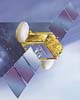
The successful launch Thursday of India's heaviest satellite from spaceport of Kourou in French Guyana may have boosted the country's space research efforts to yet another level, but it has also lifted the spirits of at least three Direct-To-Home televisions broadcasters, one of which has been waiting for years to launch its services in India. |
|
|

|
|
|
|
|
|
|
|
|
|
|
|
| The content herein, unless otherwise known to be public domain, are Copyright 1995-2006 - SpaceDaily.AFP and UPI Wire Stories are copyright Agence France-Presse and United Press International. ESA PortalReports are copyright European Space Agency. All NASA sourced material is public domain. Additionalcopyrights may apply in whole or part to other bona fide parties. Advertising does not imply endorsement,agreement or approval of any opinions, statements or information provided by SpaceDaily on any Web page published or hosted by SpaceDaily. Privacy Statement |

