|
 |
 |
 |
 |
 |
 |
 |
 |

 |
Kon-Tiki Adventure In Space Age Style
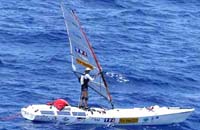
Paris (ESA) Nov 04, 2003 Assisted by ESA technology, Frenchwoman Rapha�la le Gouvello has completed a remarkable odyssey � a single-handed windsurfer crossing of the Pacific Ocean. It is a successful demonstration of just what can be achieved using renewable energy! Rapha�la le Gouvello used a custom-built windsurfer driven by the wind and generating electricity from the Sun to run its navigation systems, radio and mobile phone. An innovative airbag with space technology from the European launcher Ariane guaranteed Rapha�la's safety in the event of a capsize. And solar cells derived from technology originally developed for European spacecraft provided electricity during the crossing. Rapha�la started out on her near 8000 km journey from Peru to Tahiti on 5 August 2003, and after 89 days 7 hours and exactly 4455 nautical miles, she arrived on Sunday 2 November at Tahiti. Hers is an adventure to compare to that of Norwegian navigator Thor Heyerdahl's legendary journey from the coast of Peru to Polynesia aboard his Kon-Tiki balsa wood raft in 1947 - he crossed the Pacific in 101 days. But this was not the first time extreme sports adventurer Rapha�la le Gouvello has confronted big challenges. Forty-three years old, Rapha�la is a veteran solo navigator. She is the only woman in the world to have crossed both the Atlantic (in 2000) and the Mediterranean (in 2002) alone on a sailboard. "The Atlantic Ocean has shown me how painful it could be for a person to be alone on the ocean, stuck with no wind," Rapha�la explained before the start of her latest trip. "The Mediterranean Sea was a provoker of strong emotions with its beauty, along with its changing mind and its sometimes vicious waves. Each time you take off to sea, you have to be prepared for new difficulties." "On the Pacific Ocean one must deal with its huge dimensions. Everything is multiplied by the scale of this ocean." For instance, the shark density is three times higher than that of the Atlantic, and therefore she decided not to fish for food on the trip: "Even if they don't attack except in very determined circumstances, a dead fish could be a lure for sharks and create a situation I couldn't control." Luckily, in the end she never encountered any aggressive sharks - instead seals and barracudas sometimes escorted her.
Using wind and sun instead of fossil energy sources Six sails � their areas ranging from 4.2 to 7.4 m2 � a carbon fibre mast and an aluminium wishbone were the only �engines', along with Rapha�la herself and her 17 years of windsurfing experience. The Sun loaded her batteries daily thanks to solar cells mounted on the board � energy that was needed to generate drinking water each day, for GPS navigation and for communication via radio and telephone. It was not always easy to tell each morning which particular sail would perform best that day. With the objective to make the crossing in about 80 days, she had to achieve an average 100 km each day, and therefore had to optimise to get the best speed � and some days were with very little or totally without wind. Day 17 was one of the more difficult days when Rapha�la hit rough weather � for more than 48 hours, she had to navigate in rough open seas with non-stop heavy showers and winds rising to 30-35 knots. On that morning she was forced to rig her sail three times to reduce its size in a sea that gave no respite - at 13:00 she decided to put on the cover and let the surfboard drift. "When the sea does not invite you to navigate, the solution is not to force the wave - patience is required," she said over the radio the next day. Another challenge was to navigate with 550 kg under her feet - whenever there is a lift, the surfboard has a delay in its reaction due to its inertia. During this lapse of time, the waves can come over the board, and the body must take the strain to avoid being thrown off. "In addition to this," Rapha�la added, "I don't have any windscreens on my glasses, so when it rains I don't see anything any more!" But maintaining mental focus is the greatest challenge for a solo ocean navigator. The days become very much the same and the only way to confirm the correct route and verify daily progress is by GPS. Short daily contact with the support team via satellite telephone was the only support Rapha�la had � plus some small jokes that her support team had written on the tape that covered the food supply. "I bet I'll end the trip with the dried fruits," she laughed over the radio one day after reading one such message. "Bread and biscuits are diminishing seriously. Freeze-dried food is almost finished." Her greatest worry, she revealed "is losing my concentration: to wake up one night, to go out to pee and to forget, because I'm so sleepy, to attach myself, and fall into the water ... that's the most common risk for solitary sailors." Asked what she misses most from home, she responded, "to have a good hot bath and sleep in a comfortable bed� On the other hand it feels good to have left all obligations behind me, they usually eat up too much of our valuable time."
Rapha�la's surfboard and space technology The board itself is a custom-built windsurfer, 7.80 m long and weighing 550 kg, including a watertight sleeping compartment. But righting such a hefty board in difficult conditions could be very hard to do. Her 2000 crossing of the Mediterranean Sea was almost interrupted when her board capsized, but with great difficulty she managed to right it. For this Pacific trip, a special airbag was developed using pyrotechnic charges. When triggered it rapidly inflates the large airbag in about a tenth of a second and tips the board back over again. "We developed these pyrotechnics for the Ariane launcher family," explains Pierre Brisson, Head of ESA's Technology Transfer Programme. "It certainly could be an extremely powerful airbag which should only be used as a last resort, as it could damage the craft." Such charges are normally used to detach items no longer needed on Ariane launcher, such as exhausted fuel tanks or protective fairings. Rapha�la described her airbag as a very important element of mission safety, one without which she would feel a lot more �at risk'. "I did not use it, and I did not wish to use it, but it was tested before and it works just fine," she told Franco Malerba, Italy's first astronaut, over the phone on 29 September. She also confirmed that the flexible solar cells worked fine, mounted on the windsurfer to provide up to 12 volts and 120 watts. They charged batteries critical for navigation, communication and production of the daily ration of drinking water, obtained from seawater by a special desalination system. On 12 volts this system can provide five litres an hour. These solar cells have been derived from technology originally developed for European spacecraft. "But what about the loneliness you are enduring?" Enquired Franco Malerba, recalling that on the Shuttle "we are indeed alone and far away but we have almost continuous communications with the mission control centre." "In this respect Rapha�la is enduring a much heavier burden, similar to astronauts flying to Mars!," explained Malerba. She said that indeed the telephone calls with the support team and Radio France was like an injection of good spirits for her: "Just the idea of many people thinking of me, sympathizing with me was like a secret wind pushing me through the waves." This sounded familiar to Malerba, as he explained once the phone call ended: "I couldn't help thinking of our friends and relatives in the Houston, during the Atlantis mission, thinking and praying for us." BOX: Rapha�la le Gouvello graduated in 1983 from the Veterinary School of Nantes which was followed by eighteen month in California (Arcata) which allowed her to achieve her Master of Sciences in Aquatic Sciences and Aquaculture. Since then Rapha�la has divided her time between navigating on sailboards and managing research and development projects in her favourite field, aquaculture, especially in application of principles of sustainable development. Rapha�la initiated windsurfing during 1976 and this has since become her passion, and her achievements include: 1982: only woman registered on the 24 hours race of La Baule, with 36 international competitors 1984: started fun board windsurfing, which she continues to practice 2000: from 25 February to 24 April completed the first Atlantic Ocean crossing on a sailboard by a woman, single-handed. From Saly in Senegal to Martinique - 2750 nautical miles in 58 days, 10 hours and 11 minutes. 2002: from 28 August to 7 September became the first to cross the Mediterranean Sea alone on a sailboard between Marseille in France and Sidi-Bou-Said in Tunisia � 550 nautical miles in 10 days, 1 hours and 38 minutes. Community Email This Article Comment On This Article Related Links ESA's Technology Transfer Programme SpaceDaily Search SpaceDaily Subscribe To SpaceDaily Express Space Technology News - Applications and Research
 TeleRay Mobile Sat TV Antenna For Japan Auto Market
 Las Vegas CA (SPX) Jan 5, 2006
RaySat has introduced TeleRay, the world's smallest satellite TV vehicle antenna, into the domestic Japanese automotive market. |
|
|

| The content herein, unless otherwise known to be public domain, are Copyright 1995-2006 - SpaceDaily.AFP and UPI Wire Stories are copyright Agence France-Presse and United Press International. ESA PortalReports are copyright European Space Agency. All NASA sourced material is public domain. Additionalcopyrights may apply in whole or part to other bona fide parties. Advertising does not imply endorsement,agreement or approval of any opinions, statements or information provided by SpaceDaily on any Web page published or hosted by SpaceDaily. Privacy Statement |