|
 |
 |
 |
 |
 |
 |
 |
 |

 |
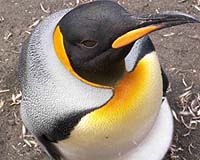
King penguins could be wiped out by climate change: study
Paris (AFP) Feb 11, 2008 One of the emblems of the Antarctic, the king penguin, could be driven to extinction by climate change, a French study published on Monday warned. In a long-term investigation on the penguins' main breeding grounds, investigators found that a tiny warming of the Southern Ocean by the El Nino effect caused a massive fall in the birds' ability to survive. If predictions by UN scientists of ever-higher temperatures in coming decades prove true, the species faces a major risk of being wiped out, they say. Second in size only to the emperor penguin, king penguins (Aptenodytes patagonicus) live on islands on the fringes of Antarctica in the southern Indian Ocean, with an estimated population of two million breeding pairs. The species is unusual in that it takes a whole year for all the birds to complete their breeding cycle -- the ritual of courtship, egg laying, incubating and chick rearing. This extreme length, spanning the Antarctic winter and summer, means the birds are vulnerable to downturns in seasonal food resources for incubating their eggs and nurturing their chicks. Their main diet, small fish and squid, depends on krill. These minute crustaceans are in turn extremely sensitive to temperature rise. The team, led by Yvon Le Maho of France's National Centre for Scientific Research (CNRS), marked 456 penguins with subcutaneous electronic tags at a big breeding ground on Possession Island on the Crozet archipelago in the southern. They buried radio antennas on pathways used by the penguins on the island and connected them to a computer that automatically recorded when the birds came and went. The surveillance programme ran from November 1997 to April 2006, a period that included an El Nino, the cyclical warming event that is not linked to climate change. During the El Nino, penguins that were early breeders did well, but those that bred later were badly hit, as the progressively warmer seas made food rarer. But the overall impact on population only became visible two years later, because of the penguins' long reproductive cycle. An increase of just 0.25 degrees Celsius (0.45 degrees Fahrenheit) in surface sea temperature translated into a nine-percent decline in an adult bird's chance of survival, Le Maho calculates. According to the UN's Nobel-winning panel of climate scientists, the mean global temperature is already set to rise by around 0.2 C (0.35 F) per decade over the next two decades as part of a longer warming trend this century. "Our findings suggest the king penguin populations are at heavy extinction risk under the current global warming predictions," the scientists say. Their paper is published on Monday by the US journal, Proceedings of the National Academy of Sciences (PNAS). Community Email This Article Comment On This Article Related Links Darwin Today At TerraDaily.com
 Living On The Red Edge
 Tempe AZ (SPX) Feb 11, 2008
A bacterium that harvests far-red light by making a rare form of chlorophyll (chlorophyll d) has revealed its genetic secrets, according to a team of researchers who recently sequenced the bacteria's genome. |
|
|

| The content herein, unless otherwise known to be public domain, are Copyright 1995-2007 - SpaceDaily.AFP and UPI Wire Stories are copyright Agence France-Presse and United Press International. ESA Portal Reports are copyright European Space Agency. All NASA sourced material is public domain. Additional copyrights may apply in whole or part to other bona fide parties. Advertising does not imply endorsement,agreement or approval of any opinions, statements or information provided by SpaceDaily on any Web page published or hosted by SpaceDaily. Privacy Statement |