|
 |
 |
 |
 |
 |
 |
 |
 |

 |
Killerbee UAV Flies At Camp Pendleton
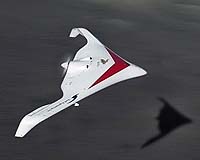
San Clemente CA (SPX) Feb 21, 2007 Swift Engineering has demonstrated its blended-wing KillerBee 3 (KB3) on February 17th at Camp Pendleton Marine Corps Base in California. Flying in support of Northrop-Grumman's Electronic Systems' Beyond Line-of-Sight Tactical UAV Communications Relay (BTCR) program in an Office of Naval Research (ONR) sponsored demonstration. Simultaneously an EPLAR and Motorola's Meshnet network relays were demonstrated. With the payload capacity of the KB3 crossbanding of these two networks was also demonstrated in the plane. Validating a tactical KB UAS can be used to enable over-the-horizon communications connectivity between troops on the move and their commanders within in a multiple network environment. The KB3 flights at Camp Pendleton marked the first time that a KillerBee UAS has flown at the historic home of the First Marine Expeditionary Force and 1st Marine Division. Looking forward, the slightly-larger blended-wing KillerBee4 (KB4) UAS will be Swift's entry in the Navy/USMC Small Tactical UAS/Tier II competition. The KB4 will provide tailored and more cost-effective support to Navy and Marine units prosecuting missions at sea and ashore. The KB4 is designed for fully autonomous use in support of expeditionary forces. It packs into two major assemblies, a trailer/launcher and ground control station, both of which can be internally transported in the MV-22, CH-53, C-130, or in an ISO-20 standard shipping container. The KBUAS' recovery system is designed for ease of handling and operation. Its lightweight, free-standing net can be erected in thirty minutes by two men and can withstand winds up to 45 MPH. The Navy and Marine Corps are in search of a UAS that will give their tactical units the persistent Intelligence, Surveillance, and Reconnaissance (ISR) support they are demanding to prosecute Global War on Terror (GWOT) missions today and tomorrow. The KB4 will do that and much more. With over three cubic feet of payload volume (nearly double that of the KB3), upwards of 66 pounds of payload capacity, and 8 to 24 hours of endurance (depending on payload and fuel tank configurations), the KB4's aerodynamic performance is unmatched by any peer competitor. With the space, weight, and power available to simultaneously carry sensors and weapons, the KB4 has the potential to be the first, genuine, runway independent, small combat unmanned aircraft system (SUCAS). Community Email This Article Comment On This Article Related Links Swift Engineering UAV Technology at SpaceWar.com UAV News - Suppliers and Technology
 UAV Tested For US Border Security
 Washington (UPI) Feb 12, 2007
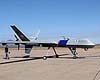
The U.S. government is pushing ahead with developing Unmanned Aerial Vehicles, or UAVs, for land border security with Canada. Officials of the U.S. Department of Homeland Security said last week they would work with the Federal Aviation Administration to impose flight restrictions around a North Dakota air base where the new UAV will be tested. |
|
|

| The content herein, unless otherwise known to be public domain, are Copyright 1995-2006 - SpaceDaily.AFP and UPI Wire Stories are copyright Agence France-Presse and United Press International. ESA PortalReports are copyright European Space Agency. All NASA sourced material is public domain. Additionalcopyrights may apply in whole or part to other bona fide parties. Advertising does not imply endorsement,agreement or approval of any opinions, statements or information provided by SpaceDaily on any Web page published or hosted by SpaceDaily. Privacy Statement |