
 |
 |
 |
 |
 |
 |
 |
 |
 |

 |
Keeping Things Small Keeps AeroAstro Nimble
Herndon - September 6, 1999 - 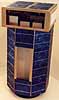 Herndon - September 6, 1999 - MicroSat pioneer AeroAstro is not just building novelty spacecraft for an uncertain consumer space market but is keenly focused on building scientific and commercial application micro and nanosats.
Dr Rick Fleeter, president of AeroAstro told SpaceDaily that one of these commercial application satellites is ESCORT. "We are planning for ESCORT to be a tiny piggyback satellite that will be released from the main satellite bus and hover nearby where it will be able to inspect the main satellite using cameras, temperature mappers and electronic-noise sensors," said Fleeter. All of which are critical for diagnosing problems with the main satellite. As yet there are no signed customers for ESCORT, but given the expense of a failed GEO satellite the demand for such nanosatellites will soon manifest itself. In addition, the opportunity to extend the functionality of nanosats and equip them with maneuvering systems may be also be possible, enabling them to be used to push against stuck mechanical parts on GEO sats and hopefully unjam them. AeroAstro is also developing "SENS" (Satellite-Enabled Notification System), a network of 12 tiny 10-kg comsats. For these AeroAstro is designing a variety of lightweight and low-cost subsystems. These include batteries, power systems, microprocessors, payload buses, attitude control systems, and communications systems both onboard and on the ground. "We are also actively pursuing development work on low-cost launch systems -- such as the "PA-E" six-ton thrust kerosene engine, which has only one-seventh of the operational costs of any comparable engine." said Fleeter. From its earliest days AeroAstro, has been structured to adapt to changing circumstances, enabling it to bounce back from the many painful learning experiences any high tech company faces as a matter of course. Dr. Fleeter - having had experience at JPL and TRW - decided when he founded the company in 1988 that it should concentrate on being relatively small and nimble. "Instead of incurring large-scale expenditures developing entirely new technologies -- which is often better left to government and large corporations -- AeroAstro is focusing on finding ingenious and productive ways to combine and utilize already-existing inventions and technological discoveries," said Fleeter. For example, the overall design for Bitsy was originally developed by the US Air Force as part of its cancelled Clementine 2 project. On a day to day corporate level, Dr Fleeter avoids an excessively rigid and static organizational structure for his company. "Often its the same people who design the overall structure of a project who also work on its more specific details." added Fleeter. Miniaturization of space technology is definitely the wave of the future, simply because it is advancing much faster than current attempts to lower actual launch costs on a per kilogram basis. As such, it can almost be said that microsats and nanosats are fast becoming the latest space technology fad. Indeed, Fleeter fears that in a some ways, the fad may already be excessive and getting ahead of available technology. One new application of small satellites that we will start seeing in the next few years is "cluster satellites" - where a multitude of small, low-cost satellites are used to make simultaneous measurements of a phenomenon over a wide area. The Magnetospheric Constellation mission -- tentatively set for 2007 -- is being designed to release a flock of 100 nanosatellites to comprehensively map the "weather patterns" of Earth's magnetosphere for the first time. The advantages of a swarm of small satellites observing Earth's weather along with environmental changes is obvious. But Fleeter warns that some of the proposals to use satellite clusters for conducting astronomical and military observations using interferometry may flounder on the critical problem of achieving highly synchronized timing between the satellites to enable simultaneous observations. Moreover, swarms of small satellites, particularly in LEO orbit, may seriously contribute to the steadily growing problem of orbital "space garbage" which could collide with and seriously damage both manned and unmanned satellites. Still -- in an age in which the benefits of decentralization are being recognized as never before -- it's hard to avoid the conclusion that the future of space exploration and its utilization may rest not only with small spacecraft, but to an even greater degree with smaller and more flexibly structured companies like AeroAstro, SpaceDev and the UK's Surrey Satellite Technology Ltd.
Email This Article Comment On This Article Related Links Space
 Satellite Launch To Boost DTH In India
 Calcutta, India (SPX) Dec 28, 2005
The successful launch Thursday of India's heaviest satellite from spaceport of Kourou in French Guyana may have boosted the country's space research efforts to yet another level, but it has also lifted the spirits of at least three Direct-To-Home televisions broadcasters, one of which has been waiting for years to launch its services in India. |
|
|

|
|
|
|
|
|
|
|
|
|
|
|
| The content herein, unless otherwise known to be public domain, are Copyright 1995-2006 - SpaceDaily.AFP and UPI Wire Stories are copyright Agence France-Presse and United Press International. ESA PortalReports are copyright European Space Agency. All NASA sourced material is public domain. Additionalcopyrights may apply in whole or part to other bona fide parties. Advertising does not imply endorsement,agreement or approval of any opinions, statements or information provided by SpaceDaily on any Web page published or hosted by SpaceDaily. Privacy Statement |

