|
 |
 |
 |
 |
 |
 |
 |
 |

 |
Katrina's Floods Leave New Orleans A Nowhere Land
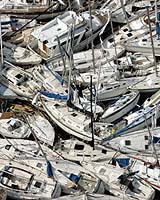
New Orleans, Louisiana (AFP) Sep 14, 2005 Each day, retreating floods surrender more of New Orleans shattered streets, exposing an eerie, silent wasteland often unfit for man or beast. Stinking slime residue bakes into a thick ash-like dust in the roasting late summer sun. Here and there, by a curbside or in a pothole, water laced with sewage stagnates. The tragedy of the people of New Orleans is written in their possessions, stolen by the floods and strewn over empty streets drying out two weeks after Hurricane Katrina's deadly storm surge. Most poignant are the children's toys: a miniature jeep sits fouled by mud on the central median of a road where it floated far from its owner's home. A toy tractor lays upside down on a sidewalk in the Mid-City district next to a rotting apple. Nearby, a book, titled "Children's Favorites : Favorite Mystery Stories" hangs open from a downed electric wire, where it was ferried by the floods. Across the road, a bedraggled Fourth of July wreath, with a paper American flag, on someone's front door recalls a happier time, when people went about their yearly rituals oblivious of impending disaster. Miles and miles of residential areas are deserted, dirtied and ghostly quiet. Most people evacuated before the storm. It would almost be possible to drive through suburbs rich and poor without seeing another person. Here and there, squads of soldiers patrol still drying streets in high wheeled trucks. Abandoned boats are everywhere, some still tied to lampposts, or sitting absurdly in the streets where they ran aground. Outside one house in the Claiborne district on Tuesday, soldiers stretched a tarpaulin over a body, grotesquely parked by receding floodwaters on somebody's front hedge. In some middle class homes, mosquito nets draped over elegant verandas have been slashed, evidence perhaps that people were rescued by boat, from waters which left a dirty tidemark two metres (six feet) high on white cladding. Historians will be able to chart the social story of New Orleans in the early 21st century by examining whose homes were consumed by floods. Poor and lower middle class people were hit disproportionately hard, as they live in low lying areas most prone to flooding. The rich and the upper middle class who dwell in sometimes palatial homes in the higher Garden District emerged untouched. Some of them were out clearing hurricane debris and even mowing their lawns as if this was any other day. Across town, in one of New Orleans most deprived areas -- in the shadow of the notorious Superdome sports auditorium where thousands took refuge -- doors of tenement type housing flapped open in the breeze. Taxis lay where they had been left by the water. Several hearses, stolen by looters, lay abandoned and fouled by muddy waters. In the back of one, someone with a ghoulish sense of humor has left a mannequin. Nearby six or seven washer dryers form an obstacle course through the slime. Down the road a marooned railcar sits on lines left rusty by two weeks in the water. In another neighborhood, the hideously ironically named Live Waters Baptist Church, a small but stained pink building with white clapboard trimming, sits in a hellish scene of muck and waste in the Elysian Fields neighborhood. On Canal Street, one of New Orleans' most famous roads, three white cars were washed up on to the steps of a church. In the Lower Ninth ward, east of the fabled French quarter, retreating floods exposed countless dead dogs. Soldiers of the Oregan National Guard said some survived the deluge, but were poisoned by the cocktail of gasoline and sewage after wading through the waters. Military experts had estimated it would take up to three months to clear the city of floods from Hurricane Katrina, but they now say it should be dry by early October. "We are pumping out nine billion gallons a day," said Susan Jackson, spokeswoman for the US Army Corps of Engineers. The Corps has mended a breach in a levee on the 17th Street canal which sent the deadly flood tide into New Orleans. Community Email This Article Comment On This Article Related Links SpaceDaily Search SpaceDaily Subscribe To SpaceDaily Express Bringing Order To A World Of Disasters When the Earth Quakes A world of storm and tempest
 New Orleans Colleges To Reopen This Week
 New Orleans, Louisiana (AFP) Jan 05, 2006
Thousands of students and faculty are returning to New Orleans' eight colleges and universities this week for the first time since hurricane Katrina flooded the city four months ago. |
|
|

| The content herein, unless otherwise known to be public domain, are Copyright 1995-2006 - SpaceDaily.AFP and UPI Wire Stories are copyright Agence France-Presse and United Press International. ESA PortalReports are copyright European Space Agency. All NASA sourced material is public domain. Additionalcopyrights may apply in whole or part to other bona fide parties. Advertising does not imply endorsement,agreement or approval of any opinions, statements or information provided by SpaceDaily on any Web page published or hosted by SpaceDaily. Privacy Statement |