|
 |
 |
 |
 |
 |
 |
 |
 |

 |
Katrina Drowns A City And Wounds A Superpower
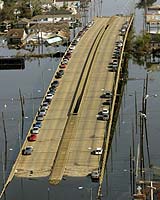
New Orleans, Louisiana (AFP) Sep 04, 2005 It started as a warning, graduated into an emergency and ended in almost unimaginable catastrophe. In the process, Hurricane Katrina laid waste to a region of the US Gulf coast the size of Britain, submerged New Orleans in corpse-strewn floodwaters and triggered a law-and-order meltdown that shocked the world. There was horrified disbelief at the scenes of destruction and suffering more usually associated with Third World disasters, that played out in the richest and most powerful country on the planet. The succession of images and first-hand testimonies -- each seemingly more harrowing than the last -- was unrelenting. Towns and cities devastated, armed gangs looting, raping and killing with impunity, bloated bodies left to rot, storm shelters swimming in human excrement and the sick and infirm dying for lack of medicine. Thousands are believed dead and the economic loss could top 100 billion dollars, according to some predictions. "It's as if an atomic bomb was dropped," US Homeland Security Secretary Michael Chertoff said Saturday. Powerful hurricanes are no stranger to the Gulf Coast and Katrina offered little hint of the devastation to come when it bruised Florida little more than a week ago and slipped into the Gulf of Mexico as a relatively innocuous tropical storm. Fuelled by the gulf's warm waters, it rapidly reached hurricane category four, sounding alarm bells through coastal Louisiana and, in particular, the southern jazz capital, New Orleans. On Saturday it was upgraded to the maximum category five, prompting New Orleans mayor Ray Nagin to order a mandatory evacuation of the city and President George W. Bush to issue a state of emergency in Louisiana. "I do not want to create panic. But I do want the citizens to understand that this is very serious," Nagin said. A few days later he was talking about "the biggest goddamn crisis in the history of this country." The evacuation order made no special provision for those without transport, and as fleeing residents clogged the highways out of New Orleans on Sunday, tens of thousands, predominantly poor and black, were left behind. Packing winds of 240 kilometers (150 miles) an hour, Katrina made landfall early Monday and swept north, flattening the coastal resort of Biloxi, cutting off power to millions and causing untold damage. At first it seemed as if New Orleans, nicknamed "The Big Easy" for its slow, easy-going pace of life, had been spared the worst. But the storm surge accompanying Katrina opened breaches in the low-lying city's network of levees, causing the waters of the adjacent Pontchartrain Lake to flood in. By Tuesday, 80 percent of greater New Orleans, home to 1.5 million people, was submerged and the city proper began a swift descent into a nightmare from the pages of Dante's "Inferno". The deadly combination of hurricane and flood caught local officials and federal disaster agencies unawares. "The devastation is greater than our worst fears," said Louisiana state Governor Kathleen Blanco. "It is just totally overwhelming." Bush cut short his holiday, emergency plans were put in action and promises made of swift and substantial relief. But by the time first significant aid arrived on Friday, hurricane survivors in New Orleans had already endured four days of anarchy as armed thugs filled the law-and-order vacuum. More than 50,000 people who had taken refuge in the two main storm shelters, the Superdome sports arena and the local convention center, were trapped in sweltering, squalid conditions without proper food, water, sanitation, power or medicines At night they were terrorised by marauding gangs and by day they waited desperately for help that didn't come. "It's like a battle zone. You gotta survive," said one desperate resident. Out on the streets, police officers, helpless to deter looters, turned in their badges in disgust. The level of chaos and destruction left officials and headline writers searching for comparisons. It was "America's tsunami," "another Hiroshima," or, in an inevitable nod to Hollywood, "The Perfect Storm." Bush, under intense criticism, acknowledged that the initial emergency response had been unacceptable as fingers of blame were pointed over the lack of preparation and coordination. After September 11, 2001, the US government spent billions of dollars and countless man hours drawing up contingency plans for scenarios ranging from poison gas attacks to a plane crashing into a nuclear power station. In the end, however, it was mother nature, not terrorists, who provided the catastrophe managers with their first real test. Nearly a week after Katrina hit, the relief situation was showing signs of improvement, as evacuation efforts gathered steam, but for many it came too late and thousands remained stranded in New Orleans. The short and long-term future for the city were equally bleak, with the grisly task of recovering and counting the dead yet to begin, and a reconstruction period measured in years. Community Email This Article Comment On This Article Related Links SpaceDaily Search SpaceDaily Subscribe To SpaceDaily Express Bringing Order To A World Of Disasters When the Earth Quakes A world of storm and tempest
 New Orleans Colleges To Reopen This Week
 New Orleans, Louisiana (AFP) Jan 05, 2006
Thousands of students and faculty are returning to New Orleans' eight colleges and universities this week for the first time since hurricane Katrina flooded the city four months ago. |
|
|

| The content herein, unless otherwise known to be public domain, are Copyright 1995-2006 - SpaceDaily.AFP and UPI Wire Stories are copyright Agence France-Presse and United Press International. ESA PortalReports are copyright European Space Agency. All NASA sourced material is public domain. Additionalcopyrights may apply in whole or part to other bona fide parties. Advertising does not imply endorsement,agreement or approval of any opinions, statements or information provided by SpaceDaily on any Web page published or hosted by SpaceDaily. Privacy Statement |