|
 |
 |
 |
 |
 |
 |
 |
 |

 |
Kalahari Desert Soils And Climate Change
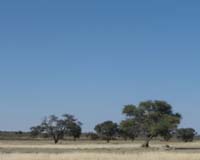
London, UK (SPX) Apr 02, 2008 The sands of the desert are an important and forgotten storehouse of carbon dioxide taken from the world's atmosphere, scientists heard today (Wednesday 2 April 2008) at the Society for General Microbiology's 162nd meeting being held this week at the Edinburgh International Conference Centre. "Desert soils are unusual because the sand grains at the surface are bound together into a crust by bacteria, reducing wind erosion and adding nutrients to the soil. Deserts cover over one third of the world's land surface and yet our understanding of their contribution to the atmospheric carbon dioxide balance is poor", says Dr Andrew Thomas of Manchester Metropolitan University. Sands like those in the Kalahari Desert of Botswana are full of cyanobacteria. These drought resistant bacteria can fix atmospheric carbon dioxide, and together they add significant quantities of organic matter to the nutrient deficient sands. "We know that globally there is a huge exchange of carbon between the atmosphere and the soil. As average global temperatures rise, scientists are concerned that bacteria will break down organic matter in soils more rapidly, releasing more carbon dioxide into the atmosphere", says Dr Thomas. "However, there have been very few actual field studies of this carbon exchange through world soils and little information on how they respond to temperature and moisture changes. This is particularly true for deserts. Here the bacteria have to be able to cope with long periods without rain and extreme temperatures, so they lie dormant in the desert soil only springing to life when there is enough moisture". The exchange or flux of carbon between the soils and the atmosphere is much smaller over deserts than for areas with more organically rich soils, but the sheer size of deserts makes it globally significant. Even small changes in the carbon balance of desert soils will also be important locally, where soil organic matter underpins fragile ecosystems currently supporting millions of poor pastoral farmers. "We discovered that even after light rainfall, the gains and losses of carbon dioxide through the sands of the Kalahari Desert were similar in size to those reported for more organic rich grassland soils. Despite being short lived, these raised pulses of activity are a significant and previously unreported contributor to atmospheric carbon dioxide" says Dr Thomas. "Global climate change models have forgotten them". Dr Thomas with his colleagues, Dr Stephen Hoon and Dr Patricia Linton also of Manchester Metropolitan University, found that in some conditions, the cyanobacteria in the surface crust were taking net amounts of carbon dioxide out of the atmosphere as they photosynthesised. But after heavy rainfall other types of bacteria deeper in the subsoil became active and their activity masked the uptake of carbon by the surface cyanobacteria by consuming the organic matter in the soil, releasing large quantities of carbon dioxide. "We also discovered that the fluxes of carbon dioxide from the soil were highly sensitive to temperature. Warmer air but similar soil moisture levels caused greater losses of carbon from the desert soils to the atmosphere", says Dr Thomas. "These desert soils are contributing significantly to the global carbon dioxide budget. Until recently they have been ignored". "We need to know exactly what is happening as a better understanding of the factors controlling activity of the surface living soil cyanobacteria could help inform grazing policy. Millions of poor semi-subsistence pastoral farmers rely on the soils of the Kalahari to provide nutrients for grazing. The carbon produced by the cyanobacteria is a major contributor to the fertility of the soil and it is essential we understand how their metabolism is affected by environmental conditions", says Dr Thomas. Community Email This Article Comment On This Article Related Links Society for General Microbiology Dirt, rocks and all the stuff we stand on firmly
 Atlantic's Molten Layers Mapped
 Cambridge, UK (SPX) Mar 28, 2008
For the first time scientists have mapped the layers of once molten rock that lie beneath the edges of the Atlantic Ocean and measure over eight miles thick in some locations. |
|
|

| The content herein, unless otherwise known to be public domain, are Copyright 1995-2007 - SpaceDaily.AFP and UPI Wire Stories are copyright Agence France-Presse and United Press International. ESA Portal Reports are copyright European Space Agency. All NASA sourced material is public domain. Additional copyrights may apply in whole or part to other bona fide parties. Advertising does not imply endorsement,agreement or approval of any opinions, statements or information provided by SpaceDaily on any Web page published or hosted by SpaceDaily. Privacy Statement |