|
 |
 |
 |
 |
 |
 |
 |
 |

 |
KIKU No 8 Deploys Large Deploy Antenna Reflectors
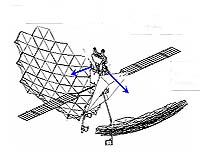
Tokyo, Japan (SPX) Dec 27, 2006 The Japan Aerospace Exploration Agency (JAXA) performed the remaining deployment operations for the large deployable antenna reflectors (LDR) onboard the Engineering Test Satellite VIII "KIKU No. 8" between 6:56 p.m. and 8:10 p.m. on December 26, 2006 (Japan Standard Time, JST) by sending commands from the Okinawa station. These included the release of the lower holding mechanism and the deployment of the reflectors for the sending antenna that were suspended. As a result, JAXA confirmed through telemetry data and images from onboard cameras sent from the satellite that the deployment of the sending antenna was successful. Images of the LDR acquired from the "KIKU No. 8" are attached below. This marks the completion of the LDR deployment. The satellite is in a stable condition. The satellite will shift to the regular attitude control mode and will progress from the critical phase to the initial functional verification phase. We expect to be able to announce the completion of the critical phase around 10:00 a.m. on Dec. 27.
Critical phase: Community Email This Article Comment On This Article Related Links Japan Aerospace Exploration Agency The latest information about the Commercial Satellite Industry Space Technology News - Applications and Research
 Swales Aerospace Completes Critical Design Review For TacSat-3 Modular Bus
 Beltsville MD (SPX) Dec 21, 2006
Swales Aerospace announced today that it has completed the Critical Design Review (CDR), for the TacSat-3 Modular Bus program, which is sponsored by the Air Force Research Laboratory's Space Vehicle Directorate (AFRL/VS), as part of the Department of Defense Operationally Responsive Space initiative. |
|
|

| The content herein, unless otherwise known to be public domain, are Copyright 1995-2006 - SpaceDaily.AFP and UPI Wire Stories are copyright Agence France-Presse and United Press International. ESA PortalReports are copyright European Space Agency. All NASA sourced material is public domain. Additionalcopyrights may apply in whole or part to other bona fide parties. Advertising does not imply endorsement,agreement or approval of any opinions, statements or information provided by SpaceDaily on any Web page published or hosted by SpaceDaily. Privacy Statement |