
 |
 |
 |
 |
 |
 |
 |
 |
 |

 |
KC-45 Advanced Aerial Refueling Boom Concludes Testing Phase
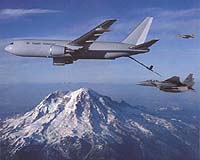
Washington DC (SPX) Aug 06, 2008 The advanced Aerial Refueling Boom System (ARBS) for Northrop Grumman's KC-45 Tanker has completed its testing and validation phase. Over the final two-day flight test period, the ARBS conducted more than 20 contacts with an F-16 fighter aircraft and, thereby, successfully achieved all remaining test objectives. Completion of the boom test program confirmed the capabilities and maturity of the ARBS, which is a key element of the KC-45 Tanker. The ARBS also is incorporated on the similar KC-30B Multi-Role Tanker Transport (MRTT) for Australia - the first of which will be delivered next year to the Royal Australian Air Force. "The ARBS test program has been a total success and has met all planned objectives," said Paul Meyer, vice president and general manager of Northrop Grumman Air Mobility Systems. "The Air Force has made it abundantly clear they need to modernize the aging KC-135 fleet as quickly as possible. Completing the ARBS test and development program clearly demonstrates that we stand ready to deliver the best capability while meeting the most demanding schedule." The ARBS test program spanned several years and included developmental testing, which began in the EADS System Integration Laboratory before moving to the ARBS Ground Test Rig. Activities then shifted to the flight phase in March 2006 with flights conducted on board the EADS A310 Boom Demonstrator aircraft. "We take great pride in achieving this historic milestone," said Ralph D. Crosby, Jr., chairman and CEO of EADS North America. "Successfully completing the test phase of the world's first all-electric fly-by-wire boom system proves we are on schedule and ready to deliver what will be the most capable, most reliable system flying today. Our men and women in uniform deserve nothing less." Over the 40-month flight test phase, the ARBS successfully refueled numerous aircraft to include F-16 fighter aircraft, NATO Airborne Warning and Control System aircraft, and proximity testing with the Royal Australian Air Force KC-30B MRTT. In total the ARBS accomplished 80 contacts and logged more than 146 flight hours during 122 sorties. Numerous wet and dry contacts were made at various altitudes and airspeeds, confirming both the ease of operation and the high nominal fuel flow rate. The large ARBS in-flight refueling envelope was fully explored, validated, and shown to be significantly larger in all axes than the KC-135's envelope. Successful completion of the ARBS flight test program will be followed by the system's final acceptance on the Royal Australian Air Force KC-30B MRTT. The ARBS, previously installed on the first KC-30B, will perform both wet and dry in-flight contacts prior to the aircraft's delivery to Australia in 2009. The all-electric ARBS provides highly accurate, reliable in-flight refueling, with a maximum nominal fuel flow rate of 1,200 U.S. gallons per minute -- 33% more than more than the KC-135 whose rate is 900 gallons per minute. Modern fly-by-wire technology incorporated in the ARBS provides enhanced controllability and includes an automatic load alleviation system that greatly aids the boom operator -- as well as the receiver aircraft's pilot -- during refueling operations. The multi-role KC-45 Tanker is derived from the highly popular A330 jetliner. The A330-based multi-role tanker/transport aircraft has won the five most recent competitions for new aerial refueling aircraft, including Australia, the United Kingdom, Saudi Arabia, the United Arab Emirates and the U.S. Air Force. Community Email This Article Comment On This Article Share This Article With Planet Earth
Related Links Northrop Grumman The latest in Military Technology for the 21st century at SpaceWar.com
 U.S. military use of robots increases
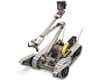 St. Louis (UPI) Aug 5, 2008
 Military robots are no longer only science fiction, with the U.S. Army planning to have 30 percent of its forces composed of robots by 2020. |
|
|

| The content herein, unless otherwise known to be public domain, are Copyright 1995-2007 - SpaceDaily.AFP and UPI Wire Stories are copyright Agence France-Presse and United Press International. ESA Portal Reports are copyright European Space Agency. All NASA sourced material is public domain. Additional copyrights may apply in whole or part to other bona fide parties. Advertising does not imply endorsement,agreement or approval of any opinions, statements or information provided by SpaceDaily on any Web page published or hosted by SpaceDaily. Privacy Statement |
 del.icio.us
 Digg
Digg Reddit
 YahooMyWeb
 Google
 Facebook