Energy News  
KAGUYA (SELENE) Observations Using The Spectral Profiler

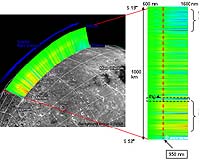
The images were produced from SP data normalized at 600 nm with a simple correction to the variation of the overall reflectance of the lunar surface and SP detectors response. The horizontal X axis of the right figure shows wavelength (600nm-1680nm) and vertical Y axis shows longitude (S19-53 degree - 1000km). The red part shows relative strong reflectance, while yellow, green and blue show weaker reflectance than the red area, respectively. The color change from green to yellow at around 950nm is expected to correspond with iron-bearing mineral distribution. For more detailed images and further explanations please go here.
by Staff Writers
Tokyo, Japan (SPX) Dec 17, 2007
The Japan Aerospace Exploration Agency (JAXA) verified the Spectral Profiler (SP) onboard the lunar explorer "KAGUYA" (SELENE) orbiting approximately 100 km above the lunar surface, through initial observations on November 3, 2007, and subsequent data analysis. The obtained data is the world's first continuous reflectance spectra of the far side of the Moon in the visible and near infrared region.

The satellite was confirmed to be in good health through telemetry data received at the Usuda Deep Space Center.

Spectral Profiler (SP)
The Spectral Profiler (SP) is a spectrometer that can obtain continuous reflectance spectra of the lunar surface from the nadir direction of the main orbiter "KAGUYA" in a broad spectral coverage (500-2600 nm) at a high spectral resolution (6-8 nm) and high spatial resolution (500 m) [Figure 1]. It will conduct, for the first time in the world, continuous global spectral observations of the Moon in the visible to near infrared region. The initial functional check of the SP on November 3, 2007, successfully produced a series of spectra along a strip longer than 1,000 km on the far side of the Moon [Figures 2-4].

Continuous visible and near infrared reflectance spectra are to be used to precisely determine the type and breakdown of minerals on the lunar surface. Ground-based spectroscopic observations of the lunar surface are limited in area coverage to the near side of the Moon and are also in spectral and spatial resolutions due in part to the effects of the Earth's atmosphere.

Observations with historical orbiters have so far been limited in spectral coverage, restricting detailed information on the lunar surface mineral composition. With unprecedented accuracy, the Spectral Profiler performs global spectroscopic mapping of the Moon with its broad spectral coverage, and high spectral and spatial resolution, which is necessary for the determination of the type and breakdown of lunar surface minerals.

In addition, one can obtain comprehensive information on the lunar surface material by combining data from the Spectral Profiler with that taken with the Multi-band Imager (MI), which measures detailed spatial distribution of minerals, as well as that from the X-ray Spectrometer (XRS) and Gamma-ray Spectrometer (GRS), which measure spatial distribution of elements. This has led to a breakthrough in research on the formation and evolution of the Moon.

Community
Email This Article
Comment On This Article

Related Links
Mars News and Information at MarsDaily.com
Lunar Dreams and more


Memory Foam Mattress Review
Newsletters :: SpaceDaily :: SpaceWar :: TerraDaily :: Energy Daily
XML Feeds :: Space News :: Earth News :: War News :: Solar Energy News


India installs antennas for planned moon mission: official

Bangalore, India (AFP) Dec 16, 2007
India has installed a pair of giant antennas to monitor a planned robotic mission to the moon next year, making it one of a few nations with deep space tracking ability, officials said.


  • Newer, Simpler Fixes Restore Corroded Pipelines
  • US lawmakers back energy bill to reduce oil consumption
  • Another Oil Bounty For Brazil
  • Analysis: British-Azeri energy ties

  • Italy begins shipments of uranium to France: report
  • Soaring energy needs, oil prices push SE Asia to nuclear power
  • Iran, Russia resolve problems on nuclear station: Moscow
  • Russian atomic power chief hails new plant in China

  • New Model Revises Estimates Of Terrestrial Carbon Dioxide Uptake
  • A Breathable Earth
  • Researchers Find Origin Of Breathable Atmosphere Half A Billion Years Ago
  • Study Reveals Lakes A Major Source Of Prehistoric Methane

  • 160-million-dollar plan to save forests launched at Bali talks
  • Niger's vanishing forests: last hope to keep desert at bay
  • Deforestation declines in Brazil for third year in a row: report
  • Greenpeace urges summit to end Africa's deforestation

  • A High Rise Apartment Complex With Built-In Greenhouse
  • Moss Is A Super Model For Feeding The Hungry
  • Fish Farms Drive Wild Salmon Populations Toward Extinction
  • Adopting New Technology In The Burdekin

  • Judge rejects automaker suit over California emissions limits
  • Truck-Safe Bamboo Bridge Opens In China
  • Feeling Guilty Over Climate Change Then Call The Solar Taxi
  • Carmakers pledge support for Bali climate talks

  • Airbus close to sale of four factories: report
  • California urges regulation on aircraft emissions
  • Announcement Of Opportunity For Sounding Rocket And Balloon Flights
  • China to order up to 150 Airbus jets during Sarkozy visit: report

  • Nuclear Power In Space - Part 2
  • Nuclear Power In Space
  • Outside View: Nuclear future in space
  • Could NASA Get To Pluto Faster? Space Expert Says Yes - By Thinking Nuclear

  • The content herein, unless otherwise known to be public domain, are Copyright 1995-2007 - SpaceDaily.AFP and UPI Wire Stories are copyright Agence France-Presse and United Press International. ESA Portal Reports are copyright European Space Agency. All NASA sourced material is public domain. Additional copyrights may apply in whole or part to other bona fide parties. Advertising does not imply endorsement,agreement or approval of any opinions, statements or information provided by SpaceDaily on any Web page published or hosted by SpaceDaily. Privacy Statement