|
 |
 |
 |
 |
 |
 |
 |
 |

 |
Jules Verne Arrives At ESTEC
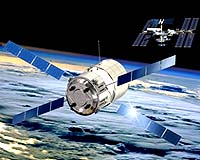
Noordwijk (ESA) Jul 21, 2004 After a long and complicated journey by air, land and sea, the Automated Transfer Vehicle (ATV) christened Jules Verne arrived at ESTEC in Noordwijk on 15 July. Jules Verne is the first of seven European supply ships for the International Space Station. It will undergo extensive testing at ESTEC over the next six months.
With flying colours This time, it's the turn of the real flight model. On Tuesday and Wednesday, the ATV's instrumentation and payload bay were flown in two Airbus Belugas (known as "superguppies") from Bremen to Schiphol. The two shipments continued their journey by boat to Katwijk, finally arriving last night at the gates of ESTEC.
Testing The ATV will be subjected to a noise level of 145 decibels (several hundred times louder than a pop concert) in order to see whether the vibration resulting from the massive noise of the Ariane 5 rockets will cause any damage during the launch. After the tank leakage tests and extending the solar panels, temperature testing will take place in the new year in the Large Space Simulator. This simulator will give Jules Verne a taste of what it will be like outside the Earth's atmosphere - extremely high and extremely low temperatures in a vacuum.
Provisioning New provisions will be carried into space at least six times over the next 10 years in a fleet of new ATVs. In all, these craft could transport as much as 7500 kilogrammes, three times more than the capacity of today's supply ship, the Russian Progress. Once the ATV has made the three-day journey to the International Space Station, it can remain there for up to six months and serve as extra work space for the permanent crew. Its motors can also be used to boost the space station to a higher orbit. But there's one more job for Jules Verne: it will bring waste material from the space station back towards Earth to be completely incinerated high up in the atmosphere. Community Email This Article Comment On This Article Related Links ATV at ESA SpaceDaily Search SpaceDaily Subscribe To SpaceDaily Express Space Station News at Space-Travel.Com
 NASA Had No Choice But To Buy Soyuz Flights
 Washington DC (SPX) Jan 09, 2006
NASA's announcement last week that it will pay Roskosmos $43.6 million for a round-trip ride to the International Space Station this spring, and an equivalent figure for an as-yet-undetermined number of future flights to the station until 2012, represents the agency's acknowledgment that it had no alternative. |
|
|

| The content herein, unless otherwise known to be public domain, are Copyright 1995-2006 - SpaceDaily.AFP and UPI Wire Stories are copyright Agence France-Presse and United Press International. ESA PortalReports are copyright European Space Agency. All NASA sourced material is public domain. Additionalcopyrights may apply in whole or part to other bona fide parties. Advertising does not imply endorsement,agreement or approval of any opinions, statements or information provided by SpaceDaily on any Web page published or hosted by SpaceDaily. Privacy Statement |