|
 |
 |
 |
 |
 |
 |
 |
 |

 |
Jules Verne ATV Engineering Systems Ready For Station
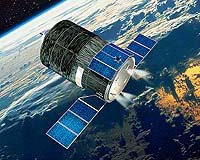
Paris (ESA) Mar 04, 2005 Preparations for the arrival of "Jules Verne", the first European Automated Transfer Vehicle (ATV), and those for ESA astronaut Roberto Vittori's mission, took a step forward when the unmanned Russian cargo spacecraft Progress M-52 docked yesterday, 2 March at 21.10 Central European Time (CET) with the International Space Station (ISS). Launched two days earlier, on 28 February at 20.09 CET from the Baikonur Cosmodrome in Kazakhstan by a Soyuz rocket as ISS mission 17P, the Progress supply vehicle carried, among other cargo, a communication system made in Europe that will be used when the ATV docks with the station in 2006. The "Proximity Communication Equipment" (PCE) will provide S-band data communication between the ISS and the ATV during the last 30 kilometres before the ATV docks. It consists of two communication assemblies which are fully redundant. The system was developed and integrated under ESA contract by EADS Astrium in Toulouse, France. Prior to its integration into the Progress vehicle, the complete PCE was checked out from 7 to 11 February by a combined ESA, industry and Russian team at the launch site in Baikonur. The equipment will be installed by the two astronauts who are now living and working in the Russian laboratory and habitation module "Zvezda", where the ATV will dock. The complete system will then be tested on the ISS in early April. The PCE will transmit to the ATV the position data obtained from the global positioning system (GPS) on board the ISS so that the ATV knows its position relative to the station throughout the approach phase up to a distance of 500m, at which point the ATV will switch from GPS navigation mode to a laser navigation mode, using a telegoniometer and a videometer for the final phase, in which docking equipment made in Russia will be used. "The ATV is the most complex and innovative spaceship ever developed and built in Europe," says John Ellwood, ESA's project manager for the ATV. "The first flight model, named after French science fiction author Jules Verne, is currently undergoing extensive tests at the ESA test facilities at the European Space Technology and Research Centre (ESTEC) in Noordwijk, the Netherlands. There, under the responsibility of the industrial main contractor, EADS Space Transportation of Les Mureaux, France, a large number of tests are being performed to verify the ATV's compatibility with the electromagnetic, acoustic and thermal environment and the space vacuum in which it will operate. This phase also serves to verify and practice certain operational procedures, such as accessing the cargo transported by the ATV. On completion of the tests, the ATV will be transported by sea to Kourou, French Guiana, from where it is to be launched by an Ariane 5 in early 2006." The Progress also carried the scientific equipment for seven experiments to be carried out by ESA astronaut Roberto Vittori during his mission to the ISS from 15 to 24 April: Agrospace, ASIA, ETD, Hand Posture Analyser, Lazio, Microspace and SPQR. Agrospace in fact consists of two separate experiments: one in which beans will be germinated in space at the same time as others are germinated by students in classrooms on Earth and another, also related to plant germination, to evaluate the feasibility of producing vegetable sprouts in space for consumption by the crew. ASIA, which stands for Analysis Experimentation Implementation Algorithms, will verify the capability of a high-performance computer board to withstand the space radiation environment in order to evaluate its possible utilisation in satellites of future generations. ETD will measure the orientation of Listing's plane with an eye-tracking device. Listing's plane is the name of the coordinate framework which describes the movement of the eyes in the head. On Earth it appears to be dependent on inputs from the body's vestibular system which controls the body's balance, orientation and posture. It is fundamental for scientists to understand how the vestibular system adapts to weightlessness and how this relates to the occurrence of space sickness. The results of the Hand Posture Analyser experiment can help to find methods of countering fatigue that can have major effects on the hand and forearms of astronauts in weightlessness. Such methods can then also be used on Earth for the treatment of patients with local trauma, muscle atrophy or diseases of the central nervous system. Lazio, the name of the region around Rome, is also an acronym for Low-Altitude Zone Ionising Observatory. This experiment will study the space radiation and magnetic environment inside the ISS, in particular with regard to the �light flashes� phenomenon. It will also assess the effectiveness of different shielding materials in reducing the radiation environment. This will be the first test in space of a sensor capable of high-accuracy monitoring of the short-term stability of the Van Allen belts, to study the possibility of earthquake-related precursor phenomena as was initially suggested by Russian scientists about two decades ago. The Microspace experiment will study the responses of microbial life to environmental factors in a space vehicle. Different microbial strains will be flown to the ISS in order to study the effects of space radiation and weightlessness on the cultures. It may improve our understanding of the basic biology of microorganisms. SPQR, for 2000 years the classical acronym for the Senate and People of Rome (Senatus Populusque Romanus in Latin) has taken on a new meaning for the Eneide mission: Specular Point-like Quick Reference. The experiment will test a ground-based imaging system, using special optics and image processing, to determine the feasibility of detecting external damage to a spacecraft in orbit from the ground. It will be based on a Cube Corner Reflector, fixed close to an ISS window, which will reflect a laser beam emitted by a ground station. Community Email This Article Comment On This Article Related Links ATV homepage SpaceDaily Search SpaceDaily Subscribe To SpaceDaily Express Space Station News at Space-Travel.Com
 NASA Had No Choice But To Buy Soyuz Flights
 Washington DC (SPX) Jan 09, 2006
NASA's announcement last week that it will pay Roskosmos $43.6 million for a round-trip ride to the International Space Station this spring, and an equivalent figure for an as-yet-undetermined number of future flights to the station until 2012, represents the agency's acknowledgment that it had no alternative. |
|
|

| The content herein, unless otherwise known to be public domain, are Copyright 1995-2006 - SpaceDaily.AFP and UPI Wire Stories are copyright Agence France-Presse and United Press International. ESA PortalReports are copyright European Space Agency. All NASA sourced material is public domain. Additionalcopyrights may apply in whole or part to other bona fide parties. Advertising does not imply endorsement,agreement or approval of any opinions, statements or information provided by SpaceDaily on any Web page published or hosted by SpaceDaily. Privacy Statement |