|
 |
 |
 |
 |
 |
 |
 |
 |

 |
Jefferson Lab Completes 100th Experiment
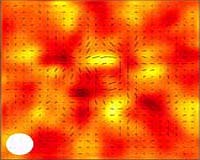
Newport News VA - June 02, 2004 The experiment, titled "Quark Propagation through Cold QCD Matter," began its run in December 2003 and wrapped up in early March. It probed Quantum Chromodynamics (QCD), a fundamental theory of particle physics that describes the interactions of quarks and gluons � the basic building blocks of matter. A property of QCD, called confinement, states that no quark can ever be found alone. Instead, quarks combine in pairs or triplets to make up larger particles. For instance, every proton and neutron contains three basic quarks. "You never find a quark by itself, in isolation. That's really a very bizarre thing and a huge mystery. So what happens when you try to get one quark alone?" Asks Will Brooks, Jlab Staff Scientist and experiment spokesperson. Jefferson Lab's accelerator is helping physicists answer that question. The electron beam is one of the few tools on Earth that can separate quarks. "You can't pull quarks apart with your fingers, but you can collide something very energetic with a quark and try to knock it out. And we have a rather simple picture of what happens when you do that." In this experiment, scientists essentially slam an electron into a single quark, knocking it out of the particle it was bound up in. But it doesn't come out alone � the energy the quark absorbs in the collision is transformed into new clusters of quarks and gluons. "If you could pull on a single quark, as it gets farther and farther away, the force between that quark and the others remains the same, but the energy you're putting into that system to move the quark is getting higher and higher. So the farther away you pull, the more energy you're stuffing in there. "And you get so much energy stored up, that a new particle could be produced, because according to Einstein's E=mc2, energy can be transformed into matter. And so a new particle just mysteriously pops out of the vacuum. And now you've got a brand new particle. And if you pull very hard for a very long distance, you can have many of these new particles appear." Scientists hope that studying this process of creating new quark-based particles, called hadronization, reveals new information about quark confinement. And by studying the new quarks and gluons, experimenters seek to understand how they were created and what happened before they coalesced into new multi-quark particles. "Normally, all you measure are the particles that come out, long after that other process [hadronization] is done. So the idea is to use the nucleus as a laboratory. If you knew everything about the nucleus, and then you initiated some process inside one that you want to study, then you could use your understanding of the nucleus to understand what's going on." To that end, the experiment used five different targets � composed of nuclei with different numbers of protons and neutrons. Deuterium, which holds the simplest nucleus containing both a proton and a neutron, was used, as well as carbon, iron, tin and lead. Brooks says now that data collection is complete, the next step is to calibrate the data. "Once it's calibrated and processed, we'll know whether there's something very unexpected. And we'll have preliminary results around 6 months after that. We might have publishable results one to two years after that. It takes a long time." In the meantime, the experimental team, comprised of CEBAF Large Acceptance Spectrometer (CLAS) Collaboration members, is looking to the future. Brooks says improved beam energies should provide even better data. "The CEBAF 12 GeV Upgrade would be a very fine place to do the ultimate experiment of this kind, and it's in our plans." Brooks says Jlab's 100th experiment was run concurrently with its 101st experiment: "Q2 Dependence of Nuclear Transparency for Incoherent ?0 Electroproduction," a search for color transparency, another prediction of QCD. "In Hall B, you can do more than one experiment at a time. For instance, the first Hall B run had 13 experiments." Jefferson Lab ran its first experiment in 1995. Titled "The Energy Dependence of Nucleon Propagation in Nuclei as Measured in the (e, e'p) Reaction," the experiment began its run in Hall C and was completed in December 1995. Community Email This Article Comment On This Article Related Links Jefferson Lab SpaceDaily Search SpaceDaily Subscribe To SpaceDaily Express Nuclear Space Technology at Space-Travel.com
 Carina Nebula Dust Pillars Harbor Embedded Stars
 Boulder CO (SPX) May 31, 2005
Astronomers using NASA's Spitzer Space Telescope have imaged a giant molecular cloud being shredded by howling stellar winds and searing radiation, exposing a group of towering dust pillars harboring infant stars, according to a University of Colorado at Boulder researcher. |
|
|

| The content herein, unless otherwise known to be public domain, are Copyright 1995-2006 - SpaceDaily.AFP and UPI Wire Stories are copyright Agence France-Presse and United Press International. ESA PortalReports are copyright European Space Agency. All NASA sourced material is public domain. Additionalcopyrights may apply in whole or part to other bona fide parties. Advertising does not imply endorsement,agreement or approval of any opinions, statements or information provided by SpaceDaily on any Web page published or hosted by SpaceDaily. Privacy Statement |