
 |
 |
 |
 |
 |
 |
 |
 |
 |

 |
Japan's Kibo lab takes shape at space station
Washington (AFP) June 5, 2008 Astronauts added more equipment to Japan's Kibo lab on a seven hour space walk Thursday, as the International Space Station's newest and largest section took shape. Mission Specialists Mike Fossum and Ron Garan ventured out of the station shortly after 1500 GMT for an excursion that lasted almost an hour more than planned, to attach front and rear television cameras outside the science lab, and remove thermal covers from its robotic system. It was all in preparation for attaching the logistics module, a huge cylindrical storage unit, to the pressurized module -- Kibo's main room. The storage module will be moved by the ISS robotic arm from a temporary location to the Kibo unit on Friday. The 11.2-meter (36.7-feet) long pressure module was delivered to the ISS Monday aboard the US space shuttle Discovery and installed during the first space walk of the 14 day mission on Tuesday. Japanese astronaut AkihikoHoshide opened the huge room, large enough for four astronauts to work in. Kibo -- which means "Hope" in Japanese -- represent's Japan's and Asia's first major contribution to the orbiting international station. It already has separate modules from the United States, Russia and the European Space Agency. "This is a great moment for the Japanese folks," Hoshide said before floating into the lab. "It's a beautiful module and we have a new hope on the space station." Showing off the 15-tonne lab's roomy interior, the eight astronauts and two Russian cosmonauts performed backflips and twirled as they floated around Kibo. When Kibo is completed -- its third main component, an exterior "balcony" for holding experiments exposed to the micro-gravity of space, is planned for a shuttle mission next year -- it will allow the ISS to double its occupancy to six astronauts. The lab will allow astronauts to carry out experiments in medicine, biology and biotechnology, material production and communications, both in a pressurized environment and completely exposed to space. The facility will be jointly monitored from the Japan Aerospace Exploration Agency's Tsukuba facility and NASA Mission Control in Houston, Texas. The US space agency, which hopes to complete construction of the ISS in 2010, considers the station a central part of space exploration ambitions, allowing scientists to study the effects of microgravity on humans. On Sunday astronauts will undertake the third spacewalk of the current mission, the principal tasks of which are to finish outfitting Kibo and to remove and replace a nitrogen tank assembly. They will also reinstall an external television camera that was removed during Thursday's walk to deal with its failing power supply. Another key issue of the overall mission was taken care of Wednesday: repairing the ISS's malfunctioning Russian-made toilet, the only one on the ISS. After the toilet's urine disposal system went haywire last week, NASA and Russia scrambled to get parts aboard Discovery to for a plumbing job. Cosmonaut Oleg Kononenko toiled away in the Russian Zvezda module for more than two hours, successfully replacing the toilet pump and installing new hoses brought by Discovery. After three tests showed no malfunction, Moscow Mission Control gave the station crew a "go" to use the facility again, the US space agency said. Community Email This Article Comment On This Article Share This Article With Planet Earth
Related Links Station at NASA Station and More at Roscosmos S.P. Korolev RSC Energia Watch NASA TV via Space.TV Space Station News at Space-Travel.Com
 Astronauts begin Kibo mission's second spacewalk
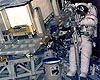 Washington (AFP) June 5, 2008
Two astronauts began Thursday the second spacewalk of their mission at the International Space Station to give Japan's new giant laboratory cameras and prepare the installation of a stowage unit. |
|
|

| The content herein, unless otherwise known to be public domain, are Copyright 1995-2007 - SpaceDaily.AFP and UPI Wire Stories are copyright Agence France-Presse and United Press International. ESA Portal Reports are copyright European Space Agency. All NASA sourced material is public domain. Additional copyrights may apply in whole or part to other bona fide parties. Advertising does not imply endorsement,agreement or approval of any opinions, statements or information provided by SpaceDaily on any Web page published or hosted by SpaceDaily. Privacy Statement |
 del.icio.us
 Digg
Digg Reddit
 YahooMyWeb
 Google
 Facebook