
 |
 |
 |
 |
 |
 |
 |
 |
 |

 |
Japan's 'Cyberdyne' robot suit ready for hospital
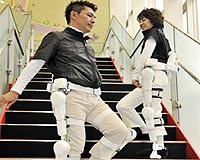
Tsukuba, Japan (AFP) Oct 7, 2008 A Japanese professor announced Tuesday he was introducing robot suits for paralysed people, helping them to walk again by detecting their next move and lifting their muscles. "The time has come to introduce this technology to the world," Yoshiyuki Sankai, a professor at Tsukuba University near Tokyo, announced at a news conference. Sankai's company producing the robot suits is named Cyberdyne Inc., the same as the sci-fi office in the "Terminator" films. But there is no risk of Arnold Schwarzenegger's character coming to blow it up. "I believe technology becomes useful only when it works for people," he said at Cyberdyne's new office. "I refuse any possible military use of my robot suits." Cyberdyne will start leasing this week 500 units of the battery-powered robot suit to assist paralysed patients at hospitals and rehabilitation centres. Sankai showed video footage of a man paralysed from the waist down standing and walking as he wore the robotic limbs. The robot suits -- dubbed HAL, or "Hybrid Assistive Limb" -- detect natural electrical currents that pass over the surface of the skin anticipating muscle movement. HAL, which weighs 11 kilograms (24 pounds), then automatically moves the muscle in the way the person intended. "You don't feel the weight of the robot at all," said Takashi Hama, an executive official of Daiwa House Industry Co., a Japanese construction firm investing into Cyberdyne. Another prototype of HAL allows the wearer to carry 100 pounds even though it feels like just a few pounds. "We are looking at the future use of the robot suits at construction sites, where workers have to carry heavy materials," Hama said. Cyberdyne is renting out the robot suits for five years at a time. Sankai said that some European nations, particularly in Scandinavia, have expressed interest in introducing them. Sankai's invention first came into prominence in 2006 when he helped Seiji Uchida -- who has been bound to a wheelchair since a car accident in 1983 -- try to climb a peak in the Swiss Alps. "I see big possibilities for HAL, which not only helps handicapped people move on their own but also assists caretakers in caring for someone like me," Uchida, now 46, said at the news conference. "The robot will lift the psychological burden we feel when having to ask to be lifted up," he said. While Uchida and his party failed to make it to the top of the 4,164-metre (13,661-foot) Breithorn peak, Uchida said that the robot suit made his dream come true. "I asked professor Sankai directly to help me take up the challenge of mountain climbing," Uchida recalled. "It's been two years since. I think the latest model has a better battery system and some improvement in the knee joints." Community Email This Article Comment On This Article Share This Article With Planet Earth
Related Links Hospital and Medical News at InternDaily.com
 Proton therapy may prevent later cancers
 Boston (UPI) Sep 25, 2008
 U.S. scientists say proton therapy patients have a two-fold lesser risk of developing a secondary cancer compared with being treated by photon radiation. |
|
|

| The content herein, unless otherwise known to be public domain, are Copyright 1995-2007 - SpaceDaily.AFP and UPI Wire Stories are copyright Agence France-Presse and United Press International. ESA Portal Reports are copyright European Space Agency. All NASA sourced material is public domain. Additional copyrights may apply in whole or part to other bona fide parties. Advertising does not imply endorsement,agreement or approval of any opinions, statements or information provided by SpaceDaily on any Web page published or hosted by SpaceDaily. Privacy Statement |
 del.icio.us
 Digg
Digg Reddit
 YahooMyWeb
 Google
 Facebook